Author: riaaasath@gmail.com
-
Introduction to Dakhni
This is a sample piece and a draft that will be updated and published shortly. The information presented here may not be entirely factually accurate at this stage. Please note that this repository is still a work in progress, and updates and revisions will be made periodically. It is an ongoing project that will continue to evolve over time.
Introduction
Deccani Urdu, also known as Dakhni, is a linguistic treasure that emerged from the historical interactions and cultural exchanges in the Deccan region of India. This Indo-Aryan language has its roots in the medieval period when it served as a lingua franca among diverse communities, including Muslims, Hindus, and others residing in the Deccan Sultanates. Over the centuries, Deccani Urdu evolved into a literary language under the patronage of regional rulers, contributing significantly to the development of Urdu literature. Today, it continues to thrive as a spoken language among communities in Telangana, Andhra Pradesh, Maharashtra, and Karnataka, embodying a rich blend of Persian, Arabic, and Dravidian influences.
Historical Context and Development
Deccani Urdu’s journey begins with the establishment of the Bahmani Sultanate in the 14th century, which brought about a significant cultural transformation in the Deccan region. With its capital initially at Daulatabad and later at Gulbarga and Bidar, the Bahmani rulers facilitated the spread of the Deccani language as a means of communication among the linguistically diverse populace. This period marked the beginning of Deccani Urdu’s emergence as a distinct dialect influenced by Hindavi (Old Urdu) from the north and local Dravidian languages.
Under the subsequent Deccan Sultanates, including the Qutb Shahis of Golconda and the Adil Shahis of Bijapur, Deccani Urdu flourished as a literary language. The rulers and nobility patronised poets and scholars who contributed to its rich literary tradition. Notable poets such as Muhammad Quli Qutb Shah, Ibrahim Adil Shah II, and others composed poetry and prose in Deccani Urdu, reflecting the cultural vibrancy and cosmopolitan ethos of the Deccan Sultanates.
Literary Contributions and Cultural Significance
The literary contributions of Deccani Urdu are manifold and span various genres and forms. Poets during the golden age of the Deccan Sultanates composed ghazals, masnavis, qasidas, rubais, and other poetic forms that explored themes of love, mysticism, nature, and social commentary. These works not only showcased the linguistic prowess of Deccani Urdu but also provided insights into the social and cultural milieu of medieval Deccan.
One of the significant contributions of Deccani Urdu to Urdu literature is its role in shaping the poetic traditions of the region. Poets like Wajhi, Nishati, and Ghwasi enriched the literary landscape with their works, often blending indigenous themes and motifs with Persian poetic forms and Arabic vocabulary. Wali Dakhni’s poetry had a transformative impact when it migrated northward, inspiring poets to adopt Urdu alongside or in place of Persian for their compositions. This shift marked a significant turning point as northern poets began to compose in Urdu, drawn by its expressive potential and cultural resonance, thanks in part to Wali Dakhni’s pioneering influence.
Cultural and Linguistic Fusion
Deccani Urdu’s evolution reflects a cultural fusion characterized by linguistic borrowings and influences from Persian, Arabic, and local Dravidian languages such as Telugu, Kannada, Tamil, and Marathi. This linguistic diversity enriched the vocabulary of Deccani Urdu, making it a versatile language capable of expressing complex ideas and emotions. The incorporation of regional languages into Deccani Urdu’s lexicon also facilitated intercultural dialogue and understanding among communities in the Deccan region.
Moreover, Deccani Urdu served as a bridge between different linguistic and religious communities in the Deccan Sultanates. It was not only the language of the court and administration but also a medium of expression for Sufi saints and religious scholars who propagated their teachings in the vernacular for wider accessibility. This inclusivity contributed to the cultural cohesion and syncretism observed in the Deccan region, where diverse linguistic and cultural traditions coexisted harmoniously.
Decline and Legacy
The decline of Deccani Urdu as a literary language began with the Mughal conquest of the Deccan under Aurangzeb in the 17th century. The imposition of northern tastes and patronage led to a gradual decline in the patronage of Deccani poets and scholars. Many poets migrated to Delhi and other Mughal centers in search of better opportunities, leading to a decline in the production of Deccani literary works.
Despite the decline of its literary tradition, Deccani Urdu continued to thrive as a spoken language among local communities. Its resilience can be attributed to the strong oral tradition maintained by generations of Deccani Muslims, who preserved its linguistic features and cultural nuances through storytelling, poetry recitations, and religious gatherings. This oral transmission ensured the continuity of Deccani Urdu’s legacy, even as its literary production declined.
Modern Era and Revitalization Efforts
In the modern era, there has been a renewed interest in preserving and promoting Deccani Urdu as part of India’s linguistic heritage. Scholars, linguists, and cultural enthusiasts have undertaken efforts to document and study the language’s grammar, vocabulary, and historical development. Archival projects aim to preserve literary works written in Deccani Urdu, ensuring that future generations have access to its rich literary tradition.
Moreover, educational institutions and cultural organizations have introduced courses and programs focused on Urdu language and literature, including modules that highlight the significance of Deccani Urdu in shaping regional identities and cultural expressions. These initiatives seek to foster academic interest and scholarly research while promoting a deeper understanding of Deccani Urdu’s cultural and linguistic legacy.
Cultural Impact and Contemporary Relevance
Deccani Urdu’s cultural impact extends beyond literature to music, theater, and popular culture in the Deccan region. Traditional qawwalis, folk songs, and theatrical performances continue to be performed in Deccani Urdu, showcasing its rhythmic cadence and emotive depth. Contemporary artists and performers draw inspiration from Deccani Urdu’s poetic traditions, incorporating its linguistic nuances and literary motifs into modern expressions of creativity.
Furthermore, Deccani Urdu’s influence is evident in the dialects spoken in urban centers such as Hyderabad, where Hyderabadi Urdu has emerged as a distinctive variant. Characterized by its unique pronunciation, vocabulary, and idiomatic expressions, Hyderabadi Urdu embodies the cultural identity of its speakers while maintaining continuity with broader Urdu linguistic norms.
Conclusion
In conclusion, Deccani Urdu remains a testament to the cultural and linguistic diversity of the Deccan region. From its origins as a lingua franca under the Deccan Sultanates to its role in shaping Urdu literature, Deccani Urdu continues to resonate with historical significance and cultural relevance. As we celebrate its rich literary tradition and cultural heritage, we acknowledge the enduring legacy of Deccani Urdu in connecting communities across generations and fostering a deeper appreciation of India’s linguistic mosaic.
Through scholarly research, educational initiatives, and community engagement, efforts to preserve and promote Deccani Urdu are essential for ensuring its continued vitality and relevance in contemporary society. By recognising and celebrating Deccani Urdu’s linguistic richness and cultural depth, we honour its legacy as a bridge between past and present, enriching our collective understanding of India’s cultural tapestry and linguistic heritage.
-
Abdul Jaleel عبد الجلیل
According to Naseeruddin Hashmi, Abdul Jaleel, known by his pen name Jaleel, was a distinguished poet of marsiya in Hyderabad during the early 11th century AH/17th century CE. Very little is known about his life, with the only recorded fact being his practice of composing marsiyas during the month of Muharram, which he would recite in the Ashoor Khana and at the Majalis of Sayed us Shuhada. Jaleel had two brothers, but no further details about his family have been documented. His marsiyas were characterized by their length and structural similarity to ghazals. Notably, a musaddas marsiya attributed to him exists, suggesting that Jaleel may have been the originator of the musaddas form for marsiyas. A manuscript of his marsiyas is housed in the Library of the Salar Jung Museum in Hyderabad. His work adhered to the stylistic conventions of both the Qutb Shahi and Mughal periods, maintaining a consistent and recognisable pattern throughout his compositions.
(This entry is based on Naseeruddin Hashmi’s work on Dakhni poets. Further research on this poet is still ongoing, with some speculation that he may be the same person as Abdul Jaleel Bilgrami.)Further Readings:
1. Hashmi, Naseer-Uddin. Dakan MeiN Urdu. 1st ed., Taraqqi Urdu Bureau, 1985. -
Firaaqi فراقی
Firaaqi, whose name was Syed Muhammad, belonged to a family of Sufis from Bijapur during the final years of the Adil Shahi dynasty. He later travelled to Aurangabad and eventually settled in Vellore. Firaaqi authored a mathnavi titled Mirat ul Hashr.
Further Readings:
1. Hashmi, Naseer-Uddin. Dakan MeiN Urdu. 1st ed., Taraqqi Urdu Bureau, 1985
2. Compiled by Prof. Mohiuddin Qadri Zore. Urdu Shah’paare. 1st ed., Urdu Academy A.P, 2009.
3. Hakeem Syed Shamsullah Qadri. Urdu-e-Qadeem: Urdu Zaban Ki Tareekh. 3rd ed., Matba Tej Kumar, 1967.
4. Shareef, Muhammad Jamaal. Dakan meiN Urdu Shayeri Wali Se Pehle. Edited by Muhammad Ali Asar. Hyderabad: Idara-e-Adabiyat-e-Urdu, 2004. -
Abdul Muhammad Tareen عبدل محمد ترین
Abdul Muhammad Tareen is credited with writing a mathnavi titled Shamail un Nabi on the life of Prophet Muhammad in the early 11th century. While little is known about the poet’s life, the mathnavi itself suggests that it was translated into Dakhni from Pashto. The mathnavi focuses on the noble characteristics of the Prophet Muhammad. According to Naseeruddin Hashmi, a manuscript of this work is preserved in both the Salar Jung Library and the Asafiya Library.
It is worth noting that ‘Tareen’ may also refer to a Pashtun tribe residing in southern Afghanistan and the western regions of modern-day Pakistan.
Further Reading:
1. Hashmi, Naseer-Uddin. Dakan MeiN Urdu. 1st ed., Taraqqi Urdu Bureau, 1985. -
Aaftaabi آفتابی
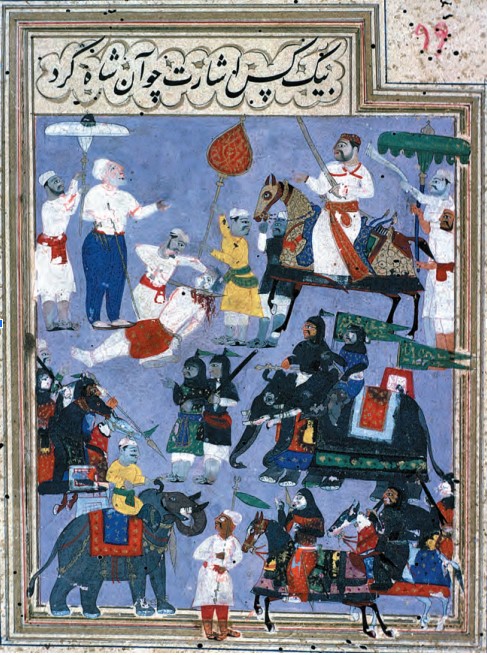
Aaftabi was a 16th-century court poet in the Nizam Shahi dynasty (1490–1636), serving under Sultan Husain Nizam Shah of the Ahmadnagar Sultanate. He is best known for his mathnavi titled Kitab-i Tarif-i Husain Shah Padshah-i Dakan (The Chronicle of Husain Shah, King of the Deccan), also referred to as Tarif-i Husain Shahi or Tarif-i Husain Shah.
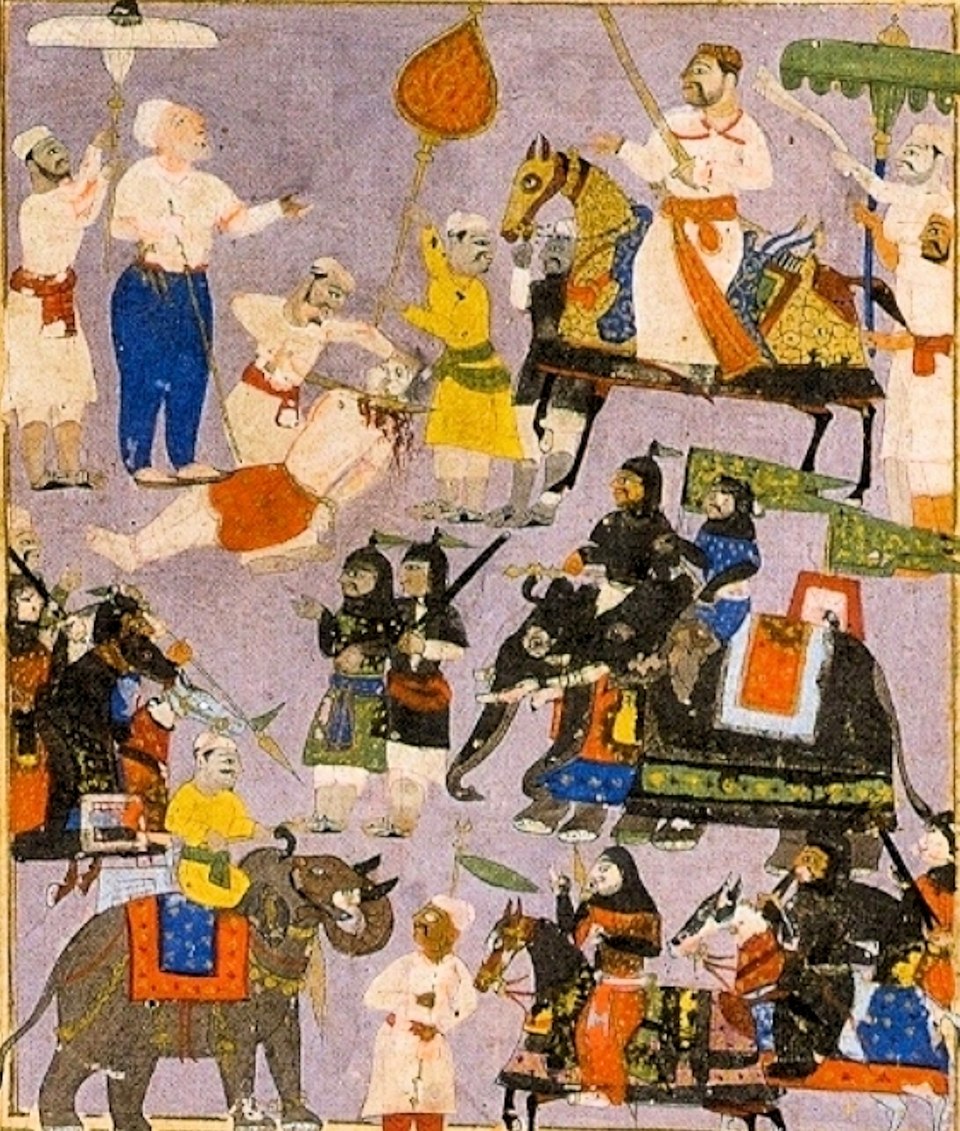
Hussain Nizam Shah I (riding a horse) orders the decapitation of Ramaraya (reigned 1542-65), the defeated ruler of Vijaianagara.
Folio 46b from the manuscript of Ta’rif-i Husain Shahi (Chronicle of Husain Shah)
Date: Circa 1565-1569
Collection: Bharat Itihas Sanshodhak Mandal, Pune.According to Naseeruddin Hashmi, this mathnavi is composed in the metre and style of Ferdowsi’s Shahnameh (977–1010 CE), and comprises of 370 couplets narrating the battles of Sultan Husain Nizam Shah while extolling the king’s virtues and those of his queen consort, Khunza Humayun.
Aaftabi’s mathnavi prominently features the Sultan’s victory at the Battle of Talikota (1565), an event that significantly shaped the history of the Deccan. The text, accompanied by vivid illustrations, provides the only contemporary poetic description of this decisive battle. Aaftabi’s portrayal of the Vijayanagara ruler Rama Raya, an adversary of Husain Nizam Shah, oscillates between condemnation—labeling him a “useless infidel” (kafir-i nabakar)—and admiration, employing poetic conventions that highlight the grandeur and might of a worthy opponent.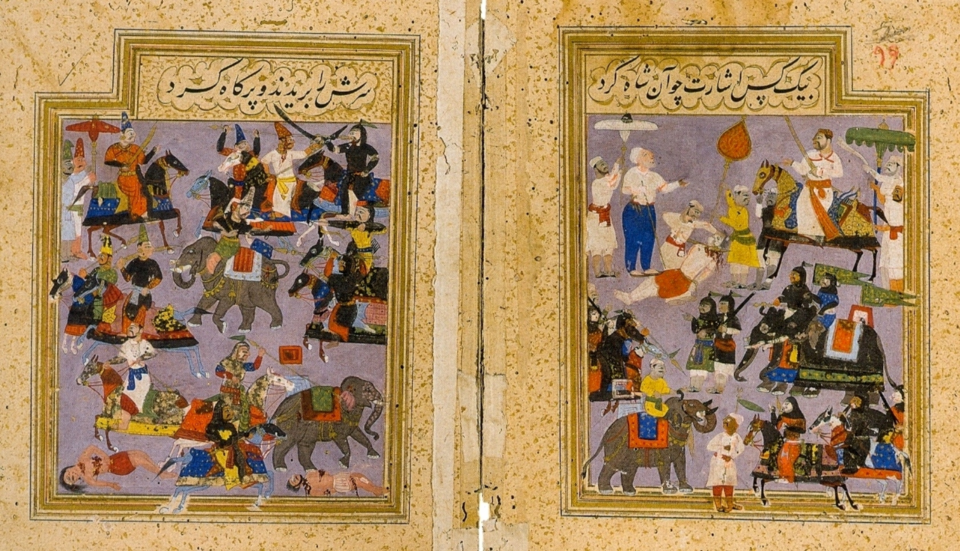
Hussain Nizam Shah I and the coalition of Deccan Sultanates decisively defeat and execute Aliya Rama Raya. Folios 46a and 46b from manuscript Ta’rif-i Husain Shahi (Chronicle of Husain Shah). In folio 46a Battle of Talikota. In folio 46b Husain Shah (riding a horse) orders the decapitation of Ramaraya (reigned 1542-65), the defeated ruler of Vijaianagara.
Date: Circa 1565-1569
Collection: Bharat Itihas Sanshodhak Manda, Pune.Further Readings:
1. Shareef, Muhammad Jamaal. Dakan meiN Urdu Shayeri Wali Se Pehle. Edited by Muhammad Ali Asar. Hyderabad: Idara-e-Adabiyat-e-Urdu, 2004.
2. Tarif-i-Husain Shah, Badshah Dakhan: original text, translation and critical introduction. India, Bharata Itihasa Samshodhaka Mandala, 1987.
3. Eaton, Richard M.. A social history of the Deccan, 1300-1761: eight Indian lives. United Kingdom, Cambridge University Press, 2005.
4. Hashmi, Naseer-Uddin. Dakan MeiN Urdu. 1st ed., Taraqqi Urdu Bureau, 1985 -
Ashraf اشرف
Shaikh Mohammad Ashraf, known by his pen name Ashraf, was a poet of the Nizam Shahi Dynasty, active during the reign of Malik Nizam ul Mulk. Little is known about his life, though it is documented that he was a disciple of Ziya Uddin. Ashraf’s most notable work is the Mathnavi titled Nausarhaar, written during this period. There is debate over his place of origin, with some attributing him to Ahmad Nagar and others to Bijapur; however, the majority of scholars believe he hailed from Ahmad Nagar.
Naseeruddin Hashmi mentions, Nausarhaar is considered the first Mathnavi in Dakhni to address the events of Karbala. The Mathnavi is divided into nine chapters, with the first chapter devoted to Hamd (praise of God), the second explaining the reasons for composing the work, and the subsequent chapters detailing the tragic events of Karbala. In his work, Ashraf reflects on his life, expressing a sense of futility and lamenting that he had not achieved anything of lasting significance.
Further Readings:
1. Hashmi, Naseer-Uddin. Dakan MeiN Urdu. 1st ed., Taraqqi Urdu Bureau, 1985 -
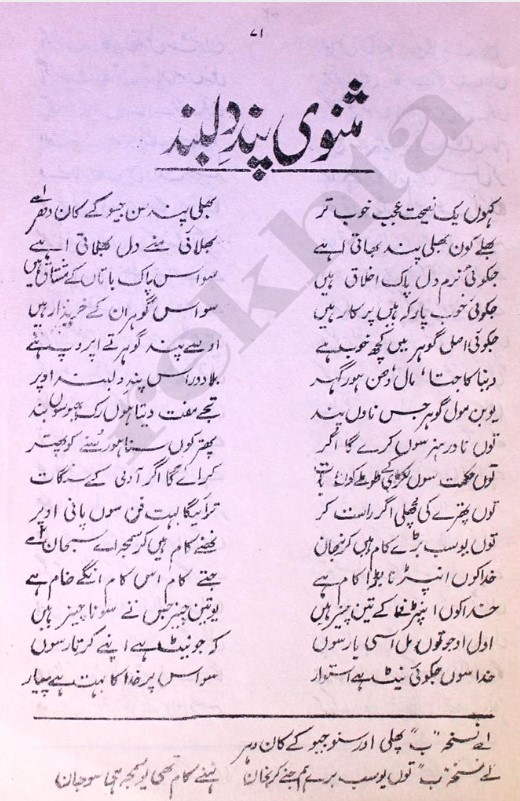
Ayaaghi ایاغی
Ayaghi’s real name was Muhammad Ameen, and he was from Bijapur, associated with the Adil Shahi court during the reign of the eighth Sultan, Ali Adil Shah II (1652–1674). Not much is known about his life, except that a mathnavi titled Najaat Naama and a few ghazals attributed to him are extant. A manuscript of his work is preserved at the Salar Jung Museum Library. Dr. Muhammad Ali Asar compiled the Najaat Naama and published it in: Dakani ki Teen Masnaviyan (1987).
Further Readings:
1. Shareef, Muhammad Jamaal. Dakan meiN Urdu Shayeri Wali Se Pehle. Edited by Muhammad Ali Asar. Hyderabad: Idara-e-Adabiyat-e-Urdu, 2004.
2. Hashmi, Naseer-Uddin. Dakan MeiN Urdu. 1st ed., Taraqqi Urdu Bureau, 1985.
3. Asar, Mohammad Ali, ed. Dakani ki Teen Masnaviyan. 1st ed. Hyderabad, India: Dairah Press, Chatta Bazar, 1987. -
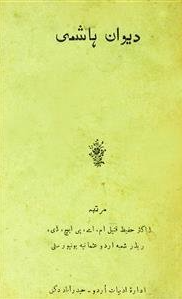
Hashmi ہاشمی
Hashmi, whose name was Miyan Khan, was a poet at the court of Ali Adil Shah II (1656–1672). The author of Basteen-us-Salateen praises him highly. After the Mughal conquest of Bijapur by Aurangzeb (Alamgir), Hashmi migrated to Irkaat, where he composed an eulogy in praise of Zulfiqar Khan, a Mughal subedaar.
Hashmi was associated with the Mahdavia faith, and some sources mention him as a disciple of Hashim Gujarati. Like many poets of his time, little is known about the events of his life. It is believed that he died in 1109 H (1697–1698 CE).
Manuscripts of his mathnavi and deewan are preserved in the Salar Jung Library, and several private collectors also possess copies. In 1099 H (1687–1688 CE), he composed a mathnavi titled Yusuf Zulekha. He is also regarded as one of the early writers of rekhti, a poetic form.
His Deewan has been published by Idara-e-Adabiyat-e-Urdu. Dr. Shareef has written in detail about Hashmi in his Dakan meiN Urdu Shayeri Wali Se Pehle (2004)
.
Note: This entry is based on Hashmi’s Dakan meiN Urdu. More can be written about the poet from various other sources. We will be updating soon; and in the meantime, if you’d like to contribute to this entry — please do!
Further Readings:
1. Shareef, Muhammad Jamaal. Dakan meiN Urdu Shayeri Wali Se Pehle. Edited by Muhammad Ali Asar. Hyderabad: Idara-e-Adabiyat-e-Urdu, 2004.
2. Hashmi, Naseer-Uddin. Dakan MeiN Urdu. 1st ed., Taraqqi Urdu Bureau, 1985 -
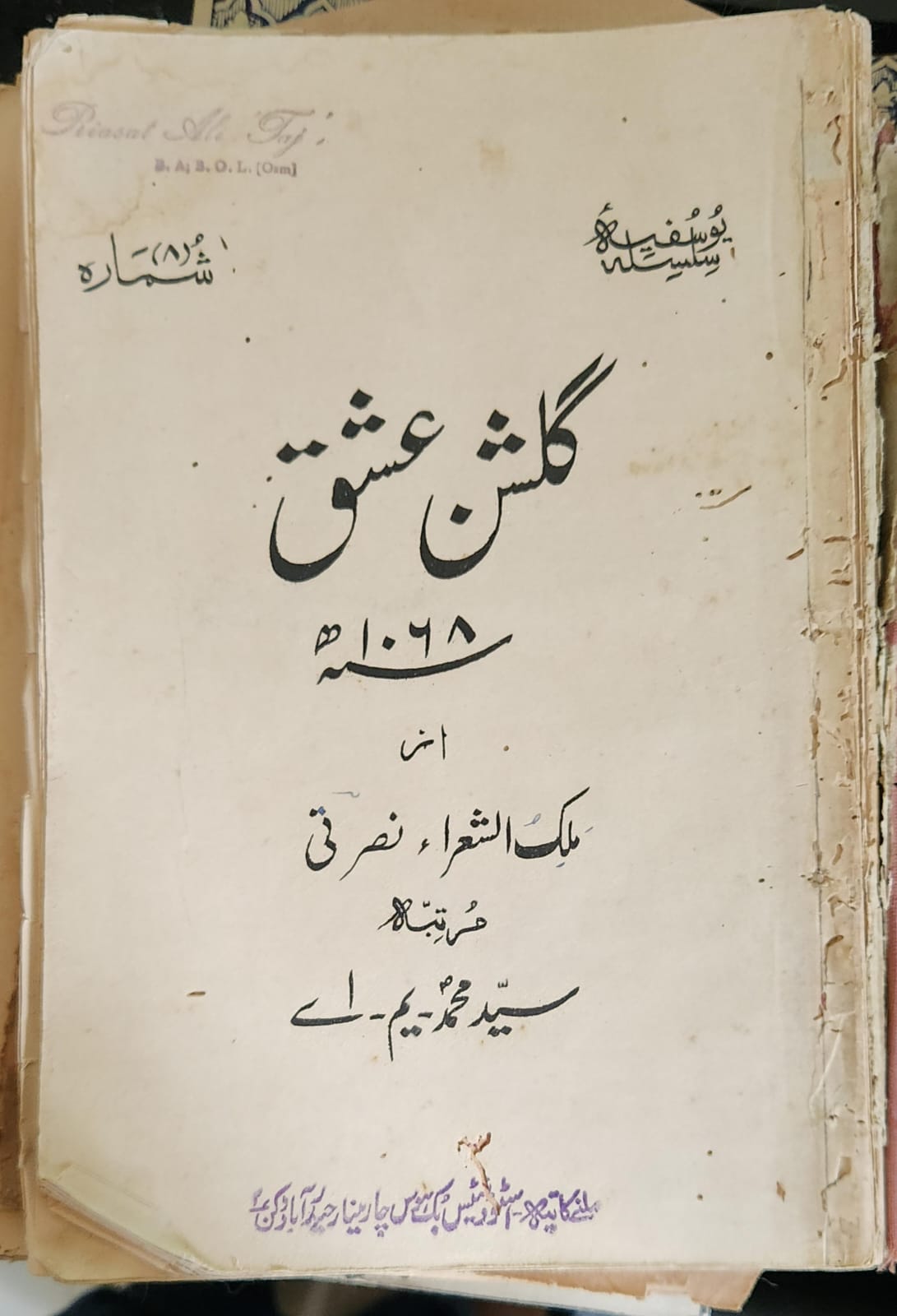
Nusrati
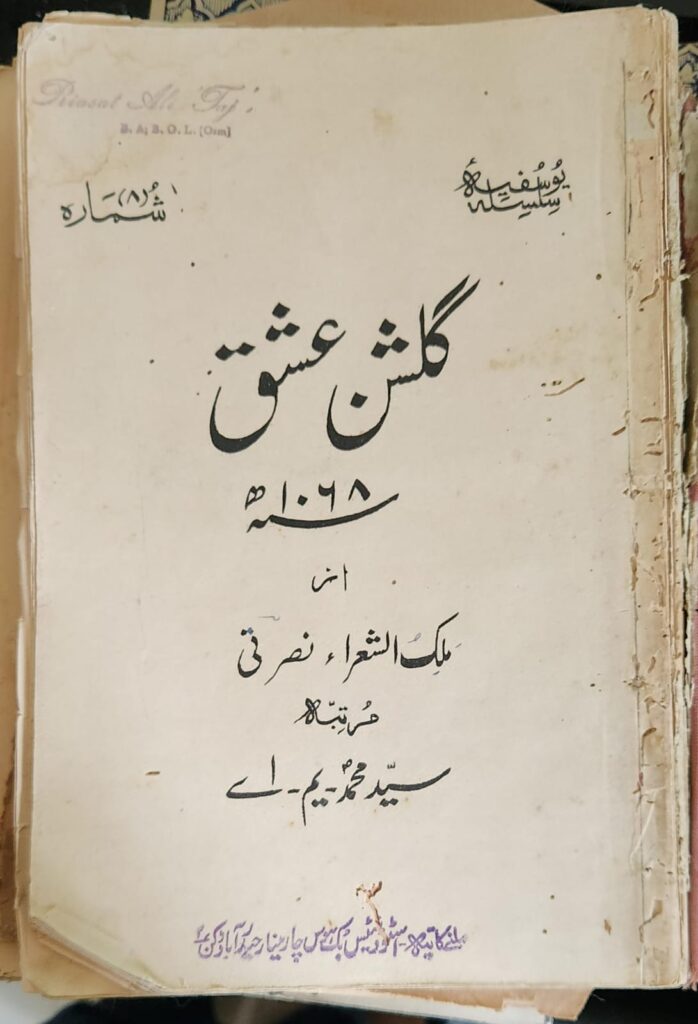
Hz. Riasat Ali Taaj (1930-1999)’s annotated copy of Gulshan e Ishq compiled by Muhammad Akbaruddin Siddiqui and published by Majlis e Isha’at e Dakni Makhtutat. -
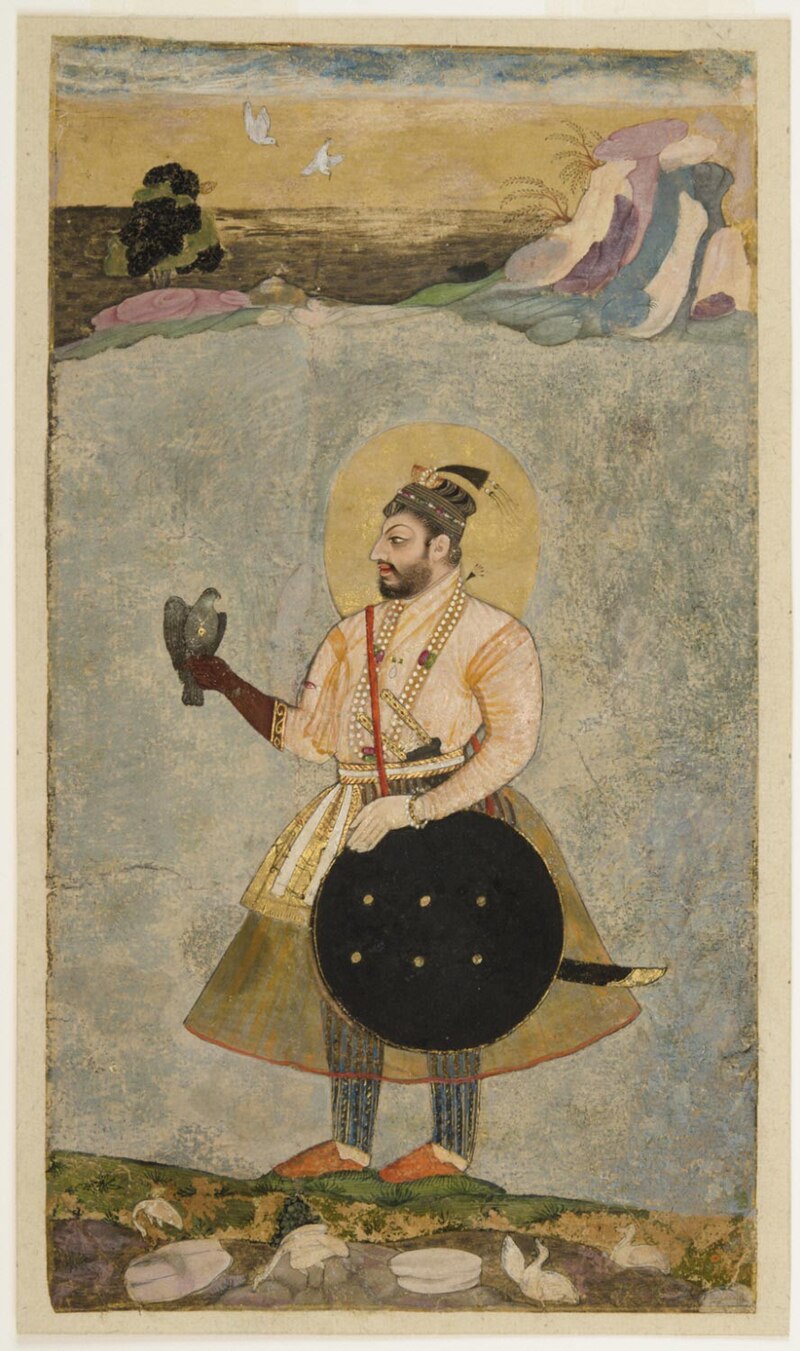
Ali Adil Shah Shahi II علی عادل شاہ شاہی ثانی
By Unknown artist – http://www.philamuseum.org/collections/permanent/96048.html?mulR=5018, Public Domain, https://commons.wikimedia.org/w/index.php?curid=9500020 Ali Adil Shah II, also known by his pen name Shahi (reigned 1067-1082), was not only a ruler but also a patron of literature and the arts, fostering a vibrant literary culture in Bijapur. He played a pivotal role in the development of Persian and Deccani literature during his reign. Ali Adil Shah II is particularly notable for his mentorship of the poet Nusrati, who was both a student and a guide to the Sultan – and mentioned the Sultan in his mathnavi Gulshan e Ishq. This relationship helped establish poetry as a widely celebrated art form in Bijapur, making it a household name in the region.
Shahi was a versatile poet, contributing to a range of poetic forms, both in complex and simple metres. His works, though largely unavailable in the past, have been compiled in a collection that showcases his mastery. His qasidas reflect his royal stature and highlight his skill in vivid depictions of themes related to power and sovereignty. His ghazals, rich in themes of love and life, further demonstrate his poetic depth. Historians have noted the richness of his language, and the responsibility of compiling his works was entrusted to Abul Muala.
Under Ali Adil Shah II’s patronage, the cultural landscape of Bijapur flourished, with notable advancements in literature, fine arts, and historical writing. His reign saw significant developments in both Persian and Deccani literature. Nusrati, serving as the poet-laureate during this period, contributed greatly to the literary legacy of the Sultan’s court. Ali Adil Shah II was laid to rest in Ali Ka Rouza, near the iconic Bara Kaman in Bijapur, a testament to his lasting influence on the cultural and literary heritage of the Deccan.Note: This entry is based on Hashmi’s Dakan meiN Urdu. More can be written about the Sultan from various other sources. We will be updating soon; and in the meantime, if you’d like to contribute to this entry — please do!
Further Readings:
1. Rifat, Syed Mubarizuddin, editor. Kulliyat-e-Shahi. Anjuman Taraqqi Urdu (Hind), 1962.
2. Sajida, Zeenat, editor. Kulliyat-e-Shahi. Ejaz Printing Press, 1962.
3. Hashmi, Naseer-Uddin. Dakan MeiN Urdu. 1st ed., Taraqqi Urdu Bureau, 1985. -
Ameen امین
The poet known by the pen name Ameen was active during the reign of Ibrahim Adil Shah II (1580-1627) of Bijapur. While the name Ameen was adopted by several poets in both Bijapur and Golconda in subsequent periods, this particular Ameen is associated with the Adil Shahi court.
Ameen is credited with composing a mathnavi titled Behram o Husn Banu بہرام و حسن بانو.Further references to this work are found in the writings of the author of Sheh Paare, who also acknowledges Ameen’s contribution. However, the author of Urdu-e-Qadeem contests the attribution, claiming that the mathnavi was actually written by Ameen Gujrati, a poet from Gujarat, rather than the poet of Bijapur. This is challenged by Dr. Shareef in his book “Dakan meiN Urdu Shayeri, Wali se pehle” (2004).
His incomplete mathnavi was later completed by Daulat, from which we get to know more details about Ameen.Further Readings:
1. Hashmi, Naseer-Uddin. Dakan MeiN Urdu. 1st ed., Taraqqi Urdu Bureau, 1985
2. Compiled by Prof. Mohiuddin Qadri Zore. Urdu Shah’paare. 1st ed., Urdu Academy A.P, 2009.
3. Hakeem Syed Shamsullah Qadri. Urdu-e-Qadeem: Urdu Zaban Ki Tareekh. 3rd ed., Matba Tej Kumar, 1967.
4. Shareef, Muhammad Jamaal. Dakan meiN Urdu Shayeri Wali Se Pehle. Edited by Muhammad Ali Asar. Hyderabad: Idara-e-Adabiyat-e-Urdu, 2004. -
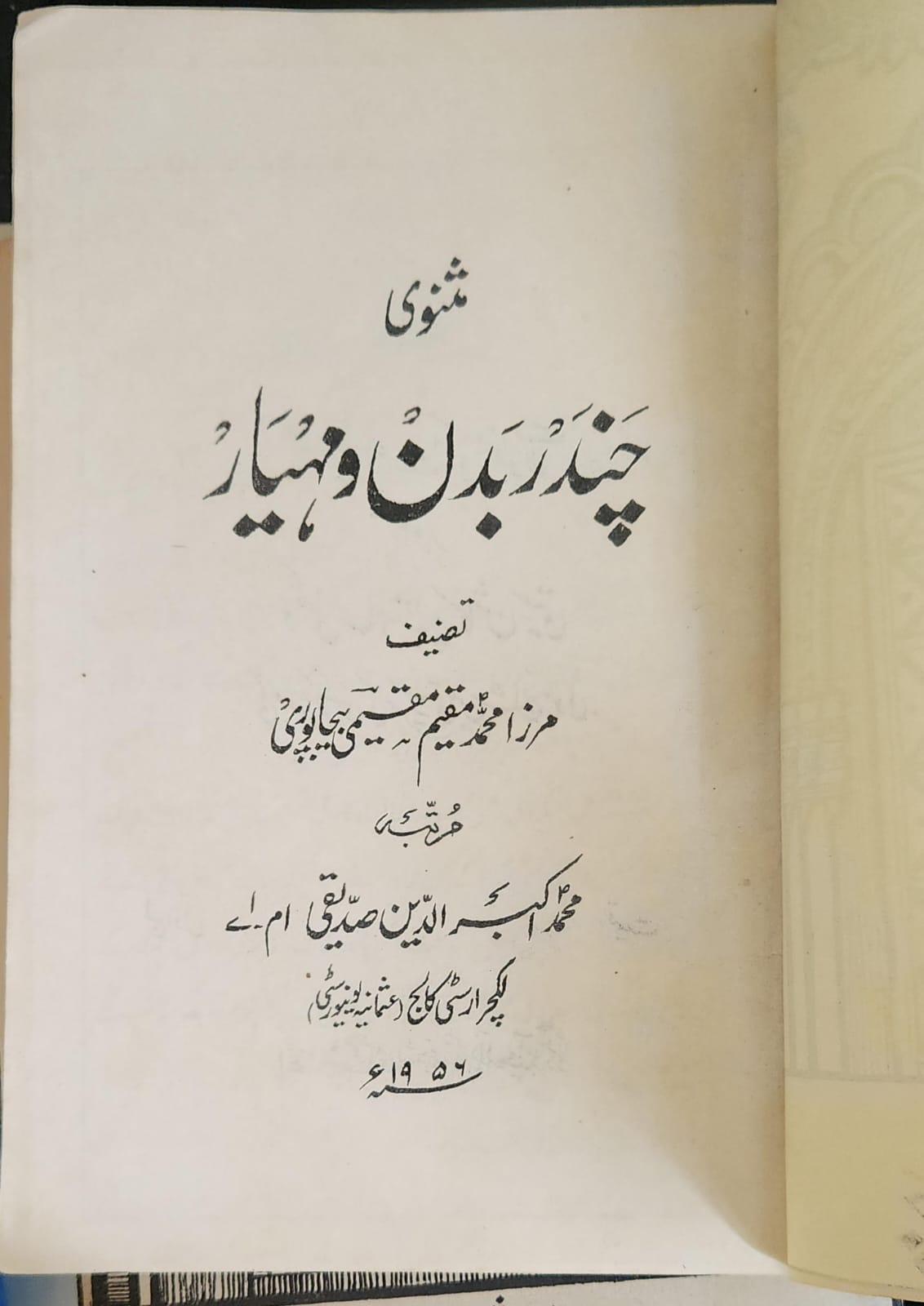
Muqeemi مقیمی
Hz. Riasat Ali Taaj (1930-1999)’s annotated copy of Chandrbadan wa Mahiyar compiled by Muhammad Akbaruddin Siddiqui and published by Majlis e Isha’at e Dakni Makhtutat in 1956. -
Abdul عبدل
Abdul was a poet in the court of Sultan Ibrahim Adil Shah II (1580-1627/988-1037) of the Adil Shahi dynasty.
According to Naseeruddin Hashmi, some sources suggest that his real name was Abdul Ghani. He is best known for his mathnavi ‘Ibrahim Nama’, which was commissioned by Sultan Ibrahim Adil Shah II and completed in 1012H/1603. The Sultan, intrigued by the idea of a unique literary work, summoned Abdul and instructed him to write a book unlike any other, stipulating that the author should be well-versed in Hindi and Dakhni, but not in Arabic. This request led to the creation of Ibrahim Nama.The work begins with hamd, naat, and manqabat, including a manqabat dedicated to Hazrat Banda Nawaz Gesudaraz, followed by the primary subject matter, which focuses on the personal life events of Sultan Ibrahim Adil Shah II. Although not a comprehensive biography, Ibrahim Nama provides significant insights into the Sultan’s private life, making it an important literary document.
One of the distinctive features of Ibrahim Nama is its linguistic composition, which blends the old Dehlvi dialect of Delhi with Dakhni, reflecting a fusion of Hindi and Persian literary traditions. This mixture is noted by Masud Husain Khan, who describes the language of Ibrahim Nama as an amalgamation of these regional dialects. The work is regarded as the first literary masterpiece of the “School of Bijapur”.
Dr. Jamaal Shareef credits Prof. Bhagwat Dayal Varma as the first person to introduce this mathnavi, who came across a manuscript of it in the library of Parti Nidhi in the Awandh princely state. He mentions the scribe’s name as Syed Abdul Raheem bin Syed Yusuf. Another manuscript of this mathnavi was found by Dr. Zore in the collections of Salar Jung.
Abdul is also believed to have been a contemporary of Muqeemi and Mullah Wajhi of Golconda, another prominent poet of the time. In his Ibrahim Nama, Abdul identifies himself as “Abdul Dehlvi,” indicating his origins from Delhi.
Further Readings:
1. Shareef, Muhammad Jamaal. Dakan meiN Urdu Shayeri Wali Se Pehle. Edited by Muhammad Ali Asar. Hyderabad: Idara-e-Adabiyat-e-Urdu, 2004. (pg. 268)
2. Khan, Masud Husain, editor. Ibrahim Nama. 2nd ed., Karnataka Urdu Academy, 1999
3. Zor, Syed Muhiuddin Qadri, editor. Abdul Ka Ibrahim-Naamah. 1st ed., Idara-e-Adabiyat-e-Urdu, n.d
4. Hashmi, Naseer-Uddin. Dakan MeiN Urdu. 1st ed., Taraqqi Urdu Bureau, 1985. -
Ibrahim Adil Shah
To be updated…
-
Burhanuddin Janam برہان الدین جانم
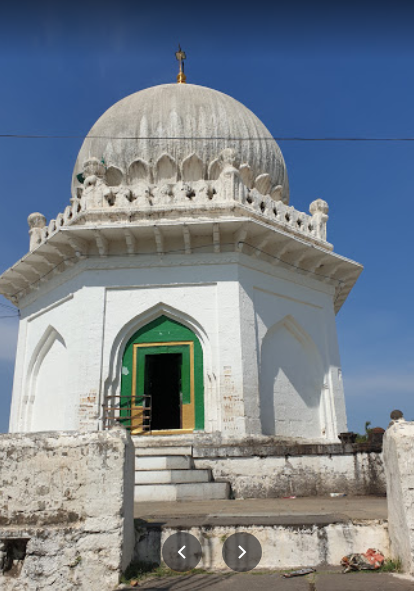
Shah Burhanuddin Janam Chishti was the son and caliph of Shamsul-Ushshaq, the saint Mira Ji of Bijapur. Born in 1543, even before the time of Surdas, he was a serious scholar and saint like his father. He was an eminent writer and prolific contributor to Sufi literature, particularly within the Chishti silsila. His shrine, Dargah Khwaja Syed Burhanuddin Janam Chishti, is located in Vijayapura (Bijapur), Karnataka. Among his notable works are Sukh-Suhela, Irshad Nama, Hujjat-ul-Baqa, Kalimat-ul-Haqaiq, Wasiyat-ul-Hadi, Muftah-ul-Iman, Nuqta-e-Wahid, Nasim-ul-Kalam, Bashrat-ul-Zikr, and Panj Ganj. Irshad Nama, written in 1582–83 A.D., is composed in a highly Sanskritized form of Dakhni and is a catechistic exposition of Chishti philosophy. Later, Kalimat-ul-Haqaiq recapitulated its contents in a more Persianized style. His language is noted to be refined and progressive, and he wrote extensively in both prose and verse, including many distichs scattered across his works. His literary output reflects deep engagement with religious philosophy and technical aspects of Chishti Sufi teachings. One of his disciples, Shah Dawal, authored Kashf-ul-Wajud. His son, Aminuddin Aala, was also a revered Sufi known for his meditative silence and reclusive nature, seldom accepting disciples, though his successors were more open in this regard. Among his few known disciples was Meeranji Khudanuma of Hyderabad.
Note: This entry is based on Hashmi’s Dakan meiN Urdu. More can be written about the saint from various other sources. We will be updating soon; and in the meantime, if you’d like to contribute to this entry — please do!
Further Readings:
1. -
Swami Keshaw Das سوامی کیشو داس
Further Readings:
1. Shareef, Muhammad Jamaal. Dakan meiN Urdu Shayeri Wali Se Pehle. Edited by Muhammad Ali Asar. Hyderabad: Idara-e-Adabiyat-e-Urdu, 2004. -
Afzal افضل
Shah Muhammad Afzal, known by his pen name Afzal, was a poet from Golconda and a Sufi disciple of Meeran Shah Maroof. He is best known for his work Mohi Uddin Nama محی الدین نامی, in which he chronicled the miracles of the famous Sufi saint Shaykh Abdul Qadir Jilani.
According to Dr. Jamaal Shareef, he was active in the period of last two sultans of the Golconda dynasty – Sultan Abdullah Qutub Shah (1625-1672) and Sultan Abul Hasan Taana Shah (1672-1682).
Manuscripts of this book have been discovered in several libraries, including the Salar Jung Library, the Asafiya Library, and in Europe. In addition to his mathnavi, Afzal composed numerous qasidas and claimed the title of Hadi ush Shuara (guide of the poets) in the tradition of qasida composition. His poetic career is linked to the reign of Sultan Abdullah Qutb Shah of Golconda, for whom he wrote a qasida.Graham Bailley has suggested that this Afzal may be the same individual who authored Baarah Maasaa or Bikat Kahaani – a work written in Hindi metres that explores Hindu life and festivals, reflecting a distinctly Indian cultural context. The poem’s depiction of a lonely wife conversing with her companions about her absent husband mirrors a common theme in Hindi poetry.
Afzal is also noted to be a contemporary of Shah Hatim (d. 1781/92), a poet from North India, during the reign of the Mughal Emperor Muhammad Shah.
Scholars dispute about whether these two authors are the same.Further Readings:
1. Bailey, Thomas Grahame. A history of Urdu literature. Oxford, Oxford University Press, 2008.
2. Hashmi, Naseer-Uddin. Dakan MeiN Urdu. 1st ed., Taraqqi Urdu Bureau, 1985. -
Fayez فائز
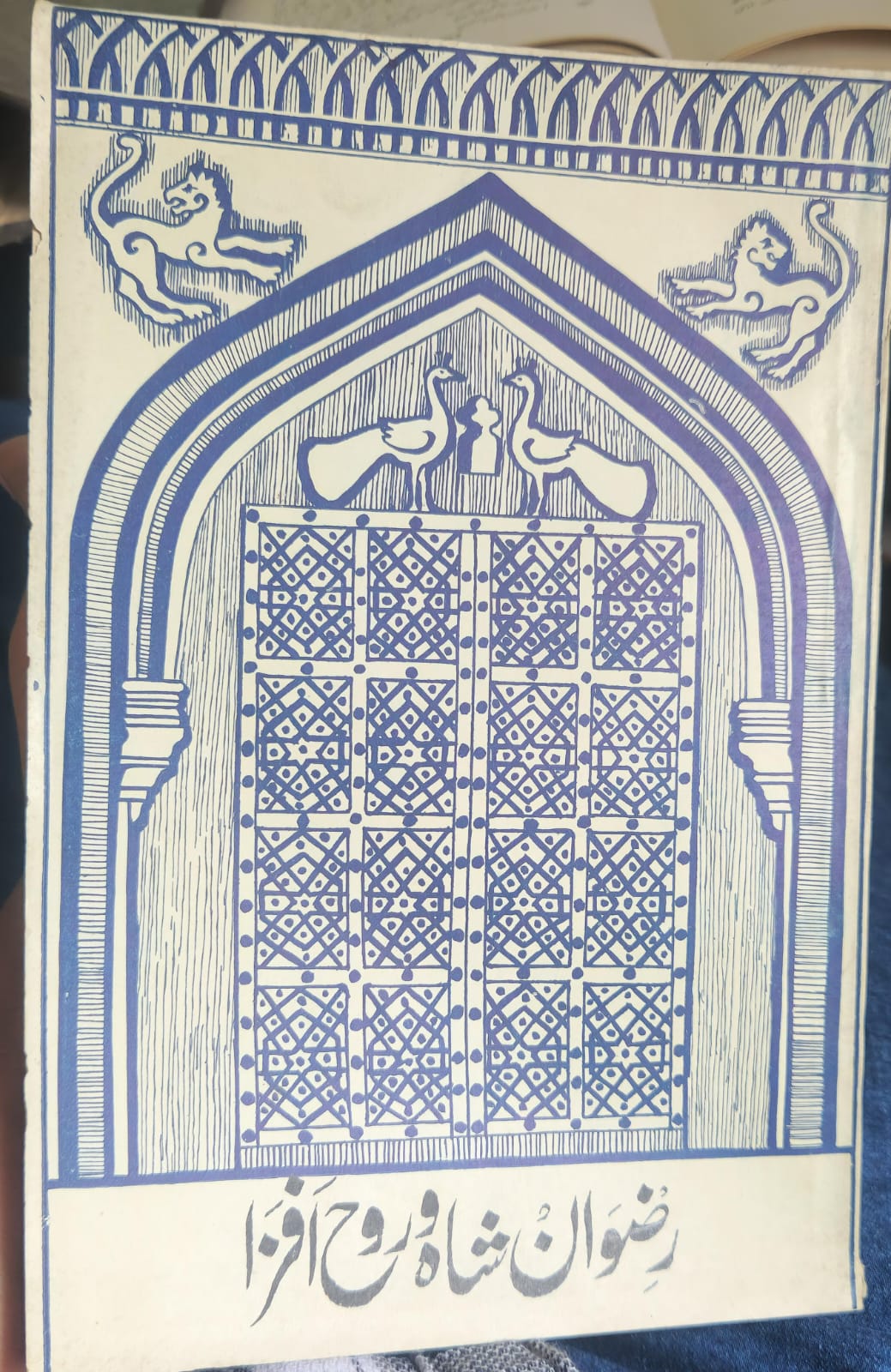
Fayez lived during the reign of the last Qutb Shahi ruler, Abul Hasan Tana Shah (1672–1686) of Golconda. Dr. Muhammad Ali Asar has published a few of his couplets and identified his real name as Muhammad Zamaan. A few years before the fall of the Golconda dynasty, in 1682 (1094 AH), Fayez composed a mathnavi titled Rizwan Shah o Rooh Afza. Originally written as a prose qissa, he later rendered it into verse. As the mathnavi contains no praise of the sultan, it is assumed that Fayez was a contemporary rather than a court poet.
The mathnavi was also compiled by Syed Muhammad, and published by Majlis e Isha’at e Dakni Makhtootat and Dakhni Sahitya Parkashan Sameti in 1952. (available in our collections)
Dr. Shareef has also discovered several marsiyahs by Fayez. Notably, Dr. A. Sprenger (d. 1893, Heidelberg), an Austrian orientalist, referred to him as فائض instead of فائز in his cataloguing.
Further Readings:
1. Hashmi, Naseer-Uddin. Dakan MeiN Urdu. 1st ed., Taraqqi Urdu Bureau, 1985
2. Shareef, Muhammad Jamaal. Dakan meiN Urdu Shayeri Wali Se Pehle. Edited by Muhammad Ali Asar. Hyderabad: Idara-e-Adabiyat-e-Urdu, 2004.
3. -
ibn e Nashati ابن نشاطی
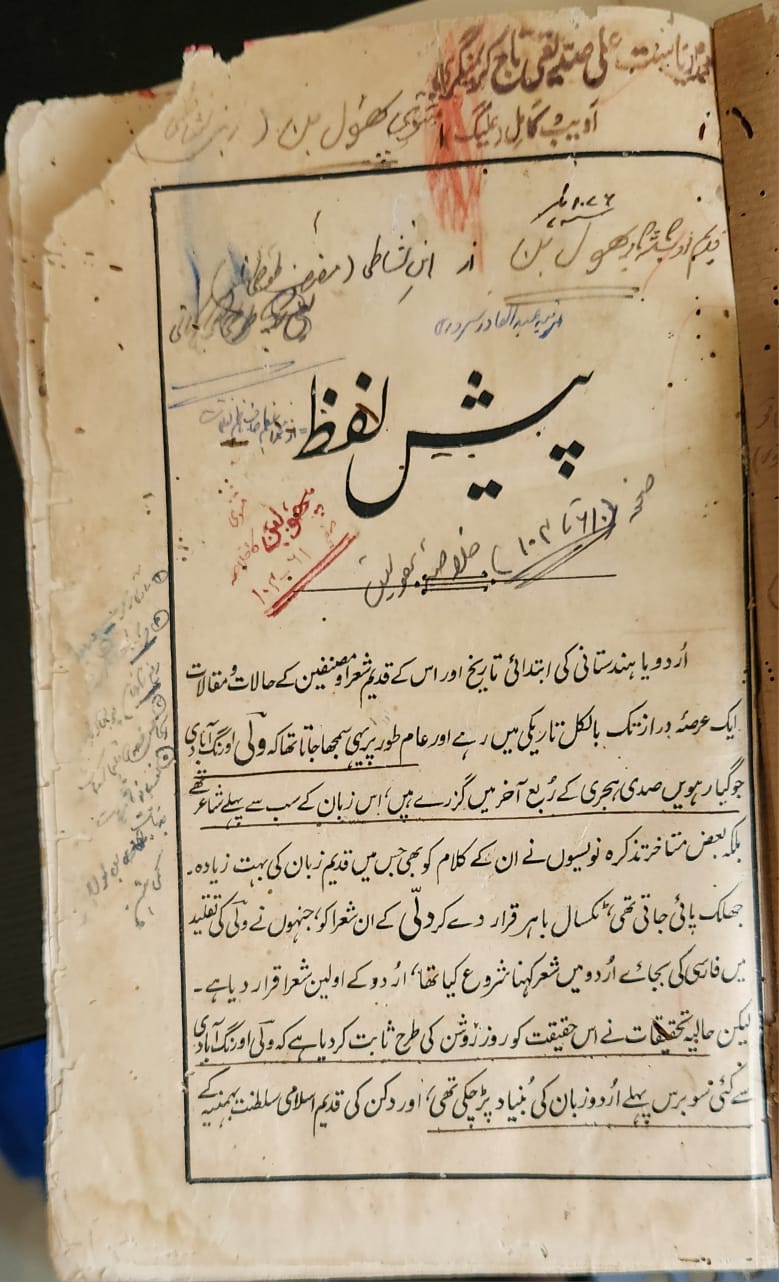
Ibn-e-Nishati was a renowned poet of his time and served at the court of Sultan Abdullah Qutb Shah (1656–1672). Though primarily known for his prose, he gained literary fame through his mathnavi Phulban, which marked his first foray into poetic composition. His full name was Muhammad Mazharuddin, and his father’s name was Shaikh Fakhruddin.
Phulban was compiled by Prof. Sarwari and published by Majlis-e-Isha’at-e-Dakni Makhtutat in 1937, accompanied by a preface and a 100-page introduction. The work was also compiled and published by Shaikh Chand bin Husain under the auspices of Anjuman Taraqqi Urdu, Pakistan.
There has been scholarly debate regarding his sectarian affiliation. While Garcin de Tassy (d. 1878), the French orientalist, and Prof. Sarwari identified him as a Shia, Dr. Jamaal Shareef has argued that Ibn-e-Nishati was a Sunni, citing the presence of manqabats in praise of the caliphs of Islam within his mathnavi.
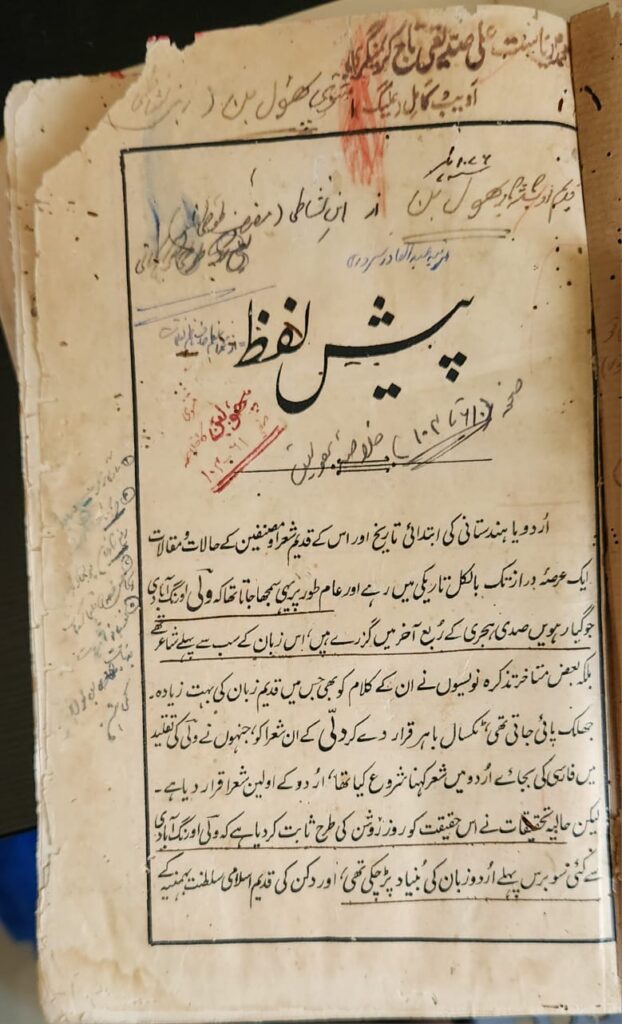
Hz. Riasat Ali Taaj’s annotated copy of Phulban compiled by Prof. Sarwari and published by Majlis e Isha’at e Dakni Makhtutat in 1937. -
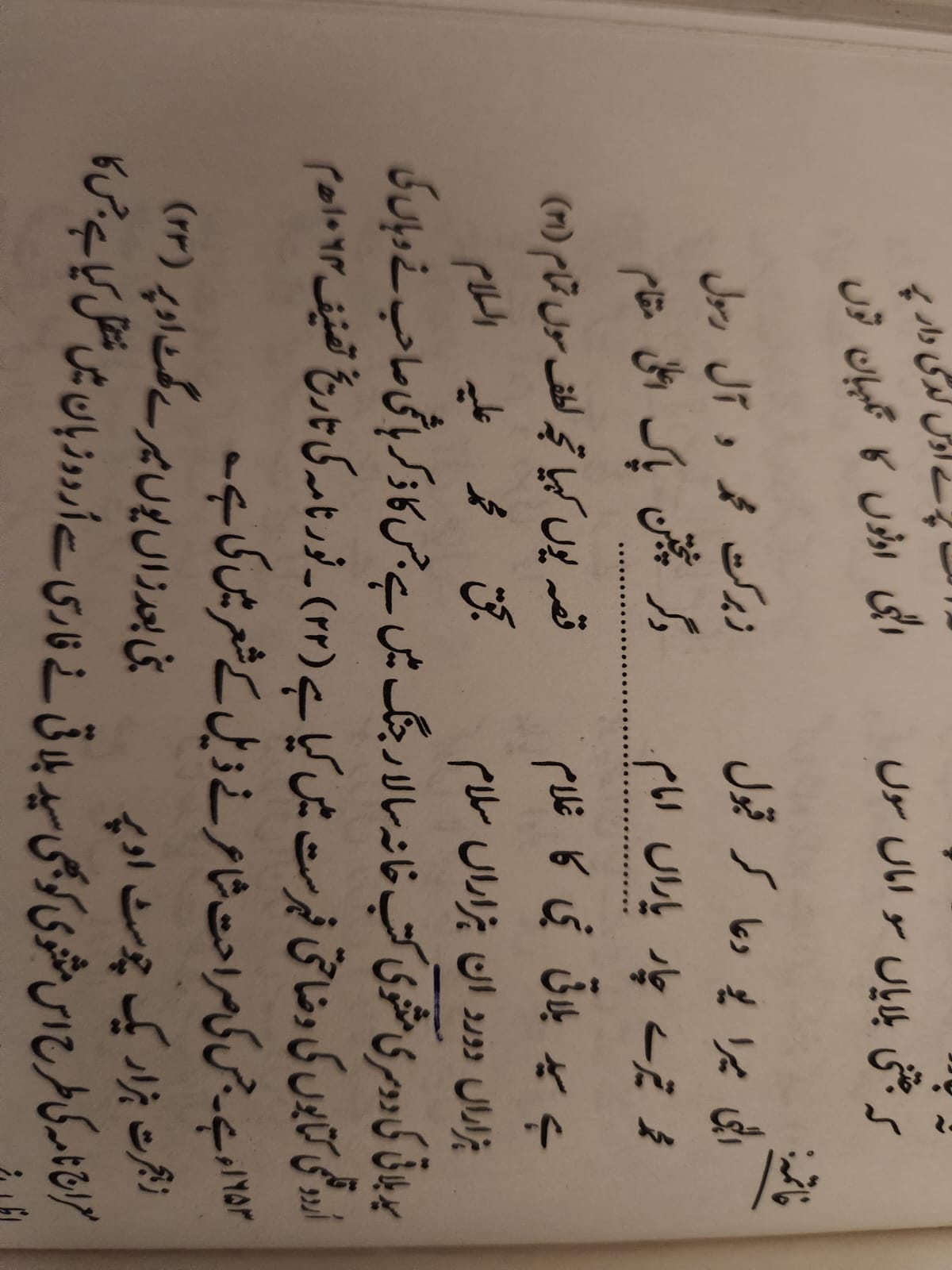
Balaaqi بلاقی
His name was Syed Balaaqi, and was from the Qutub Shahi era – although not related to the royal court.
Two of his mathnavis are known – Mi’raj naama and Noor naama (1653/1964), that were translated from Persian to Dakhni.کیا فارسی کو سو دکھنی غزل
کہ ہر عام ھور خاص سمجھیں سکلFurther Readings:
1. Shareef, Muhammad Jamaal. Dakan meiN Urdu Shayeri Wali Se Pehle. Edited by Muhammad Ali Asar. Hyderabad: Idara-e-Adabiyat-e-Urdu, 2004. (page 558) -
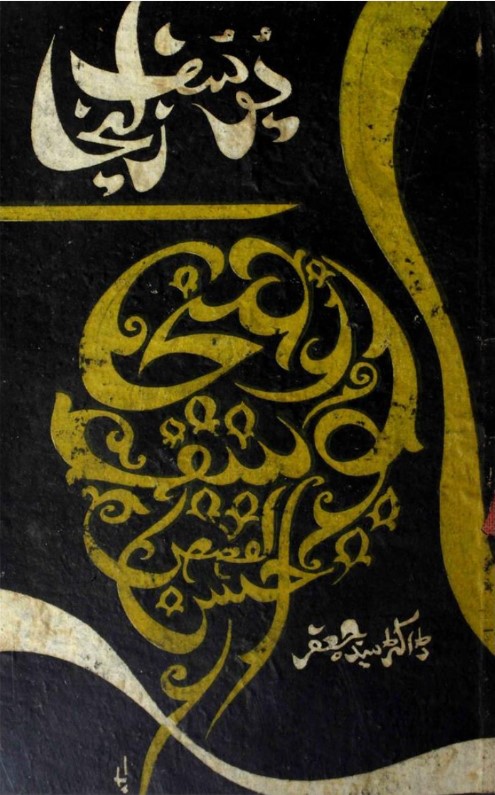
Shaikh Ahmad شیخ احمد
Ahmad was a poet from Golconda.
His work was highly regarded by his contemporaries, with Ibn Nishati, another poet of the time, referring to him as Ustad-e-Sukhan (Master of Speech), acknowledging and praising his contributions to Persian and Urdu poetry. Ahmad is known for two mathnavis: Laila Majnun and Musibat-e-Ahle Bait. The first mathnavi was commissioned by Sultan Abdullah Qutb Shah of Golconda.
The Panjab main Urdu author – Prof. Mahmood Sherwaani references this work, while the manuscript of the second mathnavi is preserved in the Library of the India Office in London. According to Grahame Bailey, Ahmad’s romance titled Laila-Majnun (written around the year 1600), of which 2,000 lines have still survived.
Dr. Jameel Jalibi also found out a mathnavi of around 4000 couplets titled “Yusuf Zulaikha“. Which was later published by Dr. Syeda Ja’afar from Hyderabad – claiming this work to be the first mathnavi of dabistan e Golconda (Golconda School of Poetry). She also mentions his name as Shaikh Ahmad Shareef Gujrati.
From the mathnavi we got to know more about his life and works. Dr. Jalibi mentions that, Muhammad Quli Qutub Shah had written a “nawaazish naama” inviting Ahmad from Gujrat to Hyderabad. He was the murid of Ahmad Shah Wajihuddin Alwi. From the mathnavi we also get to know that Ahmad knew Arabic, Persian, Telegu and Sanskrit; and was interested in grammar, logic, ‘ilm ul kalaam, jurisprudence, medicine and hikmat.Further Readings:
1. Bailey, Thomas Grahame. A history of Urdu literature. Oxford, Oxford University Press, 2008.
2. Hashmi, Naseer-Uddin. Dakan MeiN Urdu. 1st ed., Taraqqi Urdu Bureau, 1985.
3. Jalbi, Jameel. Tareekh e Urdu Adab.
4. Shareef, Muhammad Jamaal. Dakan meiN Urdu Shayeri Wali Se Pehle. Edited by Muhammad Ali Asar. Hyderabad: Idara-e-Adabiyat-e-Urdu, 2004.
5. Sayyada Jafar. Yusuf Zulekha: Dabistan-e-Golkunda Ki Pahli Masnavi. 1st ed. Hyderabad, India: National Fine Printing Press, 1983. -
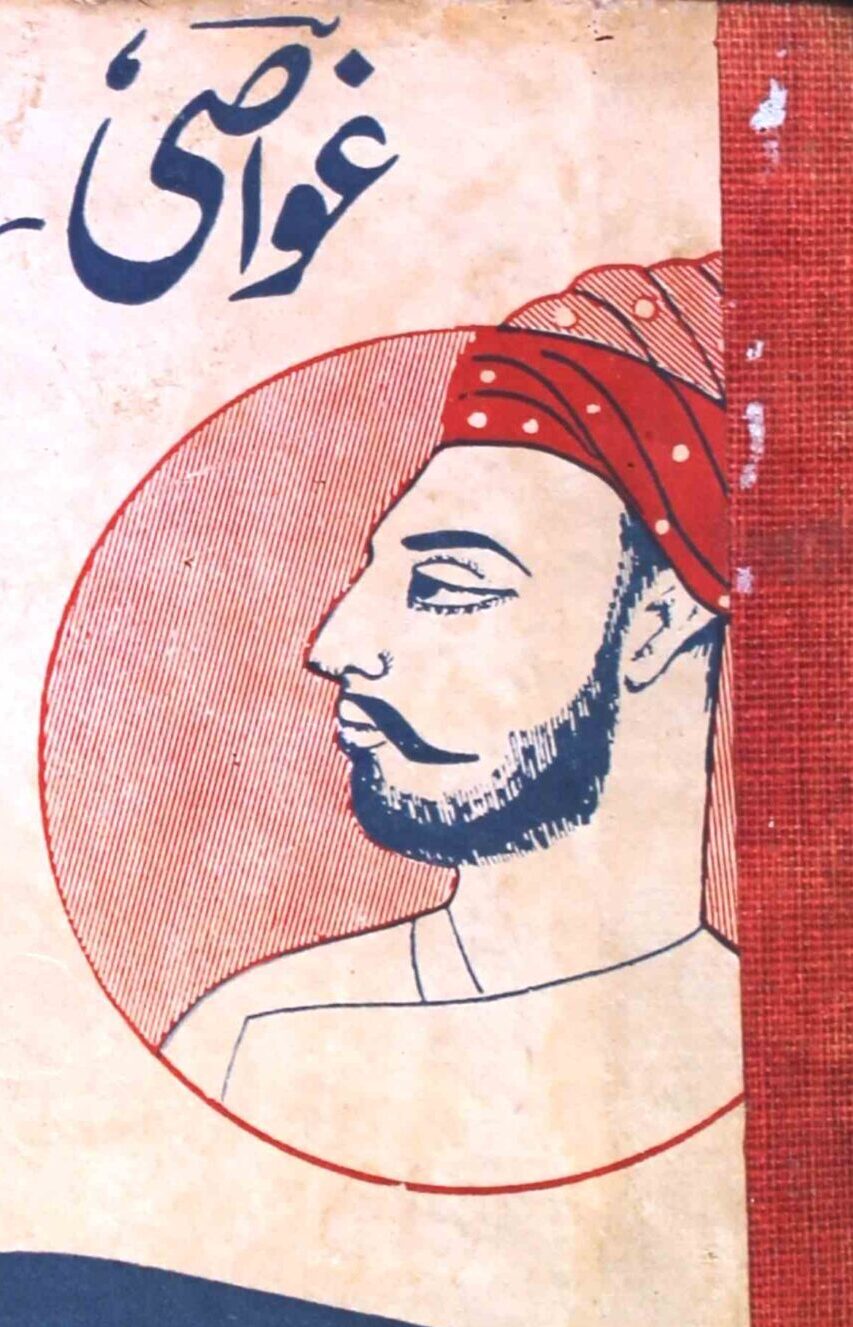
Ghawasi غواصی
Ghawwasi was a prominent poet of the Qutb Shahi dynasty, regarded as the second most renowned poet of the period. His poetry gained recognition during the reign of Sultan Muhammad Qutb Shah, and he rose to prominence in the court of Sultan Abdullah Qutb Shah (1625–1672), where he held an esteemed position. He was also appointed as an ambassador to Bijapur.
Ghawwasi’s mathnavi works were particularly celebrated. His Saif ul Mulk o Badi ul Jamal, completed in 1035 H, was a translation from Persian to Dakhni. Another major work, Tuti Nama, originally authored in Persian by Ziauddin Nakshabi, was translated by Ghawwasi and completed in 1049 H. A third mathnavi, Chanda aur Lokh (also referred to as Mina o Satwanti), translated from Persian in 1035 H, has also been attributed to him.A study of Saif ul Mulk reveals Ghawwasi’s strong self-praise and criticism of other poets, though he does not mention any names explicitly, claiming poetry belonged solely to him. In contrast, Tuti Nama reflects a tone of humility and introspection, where he expresses regret for being a worldly man (dunya-dar). His language is simple, rich in Hindi vocabulary, and devoid of ambiguity, which adds to the appeal and accessibility of his works.
Several manuscripts of Saif ul Mulk and Tuti Nama are preserved in European collections, as well as in the Anjuman Taraqqi-e-Urdu and with Agha Hyder Husain of Nizam College. The third mathnavi, Chanda aur Lokh, remains unpublished; four manuscripts are housed in the State Library, Hyderabad, and four more in the Salar Jung Library. His Kulliyat has been published by Idara-e-Adabiyat-e-Urdu. The Kulliyat, containing his ghazals, qasidas, and marsiyas, is also available at the Asafia Library in Hyderabad.
Some scholars have referred to him as Bahauddin, though this identification remains unverified. Like Wajhi, the exact date of Ghawwasi’s death is unknown, but it is generally believed that he passed away before 1060 H, during the reign of Sultan Abdullah Qutb Shah.
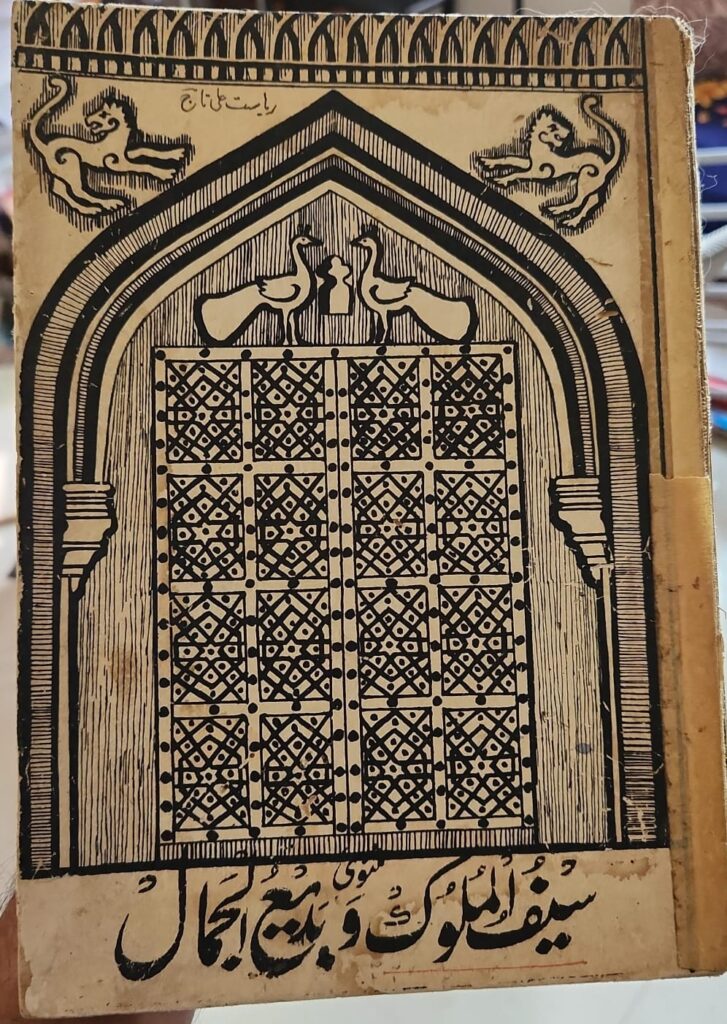
Mathnavi: Sayf al-Mulook wa Badi’ ul-Jamaal (1937) compiled by Mir Sa’adath Ali Razvi 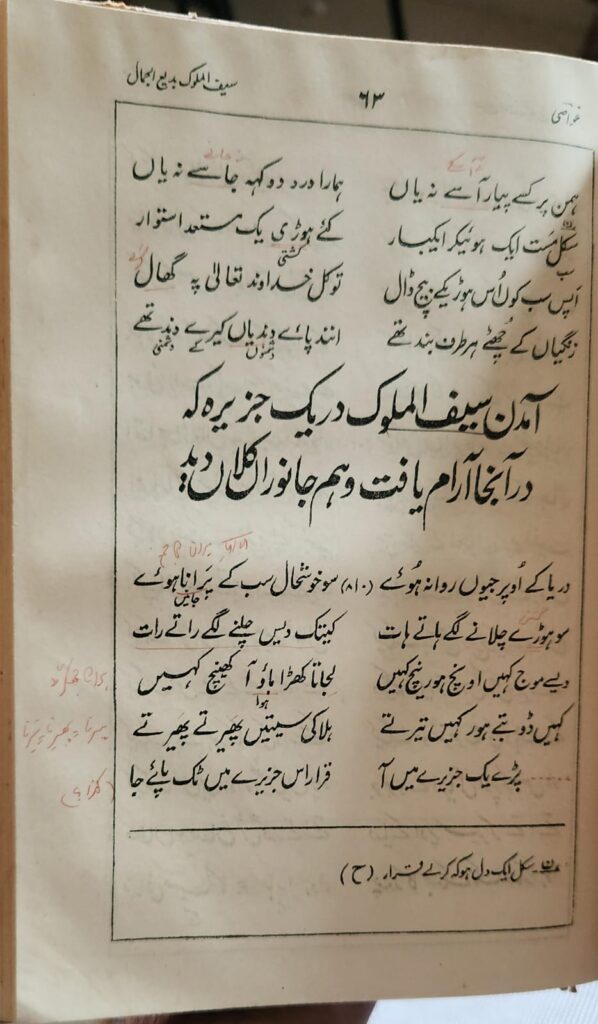
Hz. Riasat Ali Taaj’s annotated copy of Sayf al Mulook wa Badi’ ul Jamaal Note: We have two of Ghawasi’s published mathnavis in our collections.
1. Mathnavi: Sayf al-Mulook wa Badi’ ul-Jamaal (1937) compiled by Mir Sa’adath Ali RazviFurther Readings:
1. Shareef, Muhammad Jamaal. Dakan meiN Urdu Shayeri Wali Se Pehle. Edited by Muhammad Ali Asar. Hyderabad: Idara-e-Adabiyat-e-Urdu, 2004.
2. Hashmi, Naseer-Uddin. Dakan MeiN Urdu. 1st ed., Taraqqi Urdu Bureau, 1985 -
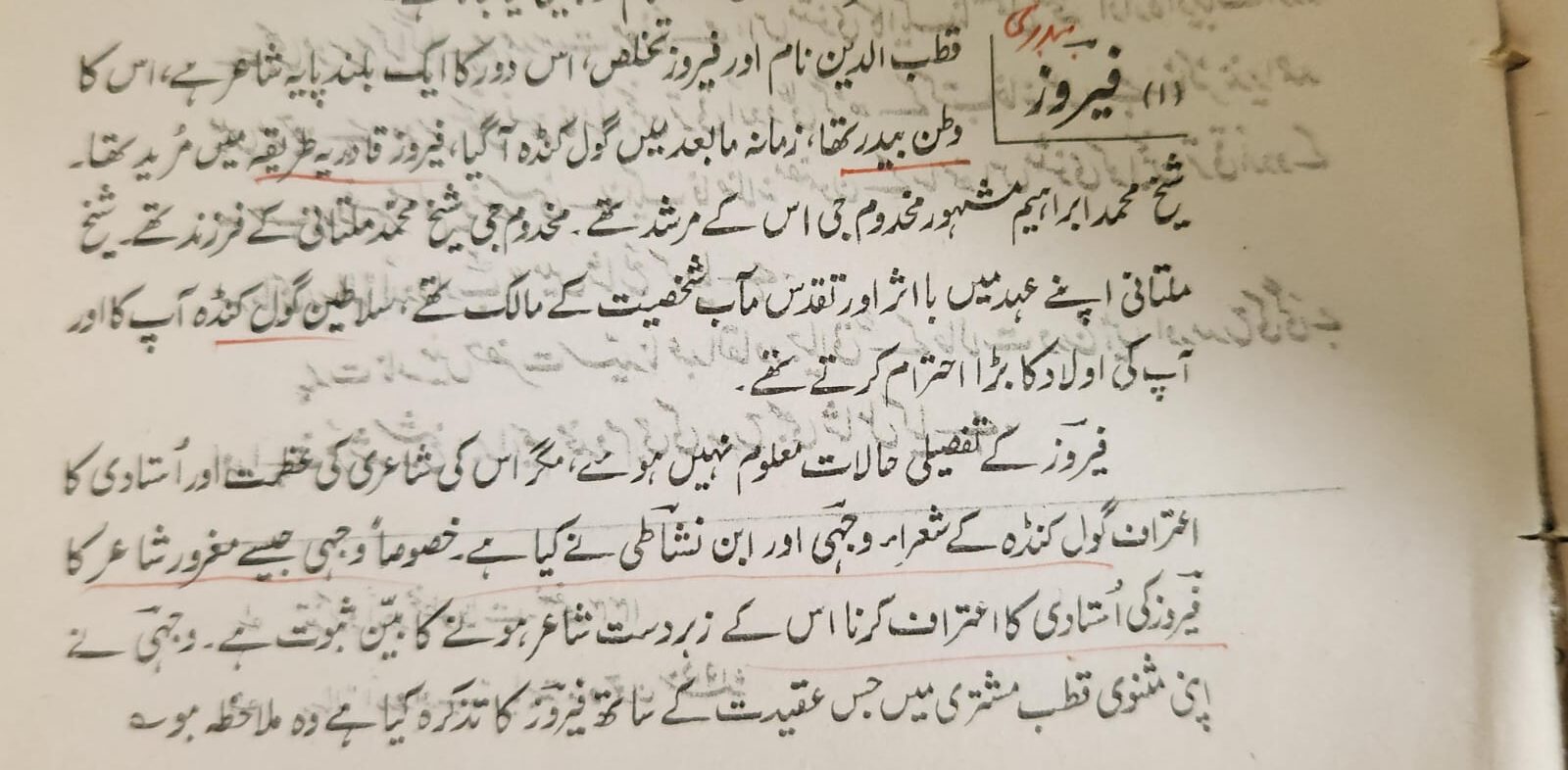
Feroz Bidri فیروز بدری
Feroz, whose name was Qutbuddin Qadri, composed a mathnavi of approximately 121 couplets in praise of Shaykh Abdul Qadir Jilani in 16th-century Bidar. The title of this mathnavi is disputed. While it is commonly referred to as Parat Naama, Dr. Zore has named it Tauseef Naama Meeraan Muhiuddin, Naseeruddin Hashmi has referred to it as Tauseef Naama, and Prof. Sarwari has used the title Parat Naama Muhiuddin. A manuscript copy preserved at the Idara-e-Adabiyat-e-Urdu carries the title Sifat Naama Muhiuddin, a title preferred by Dr. Shareef. Dr. Nazeer also wrote a paper on this mathnavi in 1957. This mathnavi was compiled by Dr. Masud Husain Khan and published in 1965 in Osmania University’s “Qadeem Urdu“.
A few of his Ghazals were also later discovered and published by Dr. Jameel Jalibi in the preface of Diwaan e Hasan Shawqi (1961), and Dr. Jamaal Shareef in Sabras (March, 1968).Feroz was a mureed in the Qadiriyya Sufi silsila of Shaykh Muhammad Ibrahim Mashoor Makhdoom, the son of Shaykh Muhammad Multani—a family held in high esteem by the Qutb Shahi royals. He was from the time of Ibrahim Qutb Shah (1550–1568). According to Tazkirah-e-Awliya-e-Dakan, the Sultan expressed a desire to meet Feroz, but the poet declined any interaction with figures of political power.
He was regarded among the astezah of the poets of his time. This is evident from the mention of Feroz with admiration by Wajhi in Qutb Mushtari (1609) and by Ibn-e-Nishati in Phulban (1665). Wajhi is said to have been a tutee of Feroz, though this claim has been disputed by scholars.
Riasat Ali Taaj’s annotated copy of “Dakan meiN Urdu” (1985). Further Readings:
1. Hashmi, Naseer-Uddin. Dakan MeiN Urdu. 1st ed., Taraqqi Urdu Bureau, 1985
2. Shareef, Muhammad Jamaal. Dakan meiN Urdu Shayeri Wali Se Pehle. Edited by Muhammad Ali Asar. Hyderabad: Idara-e-Adabiyat-e-Urdu, 2004.
3. -
Gesu-daraaz گیسو دراز
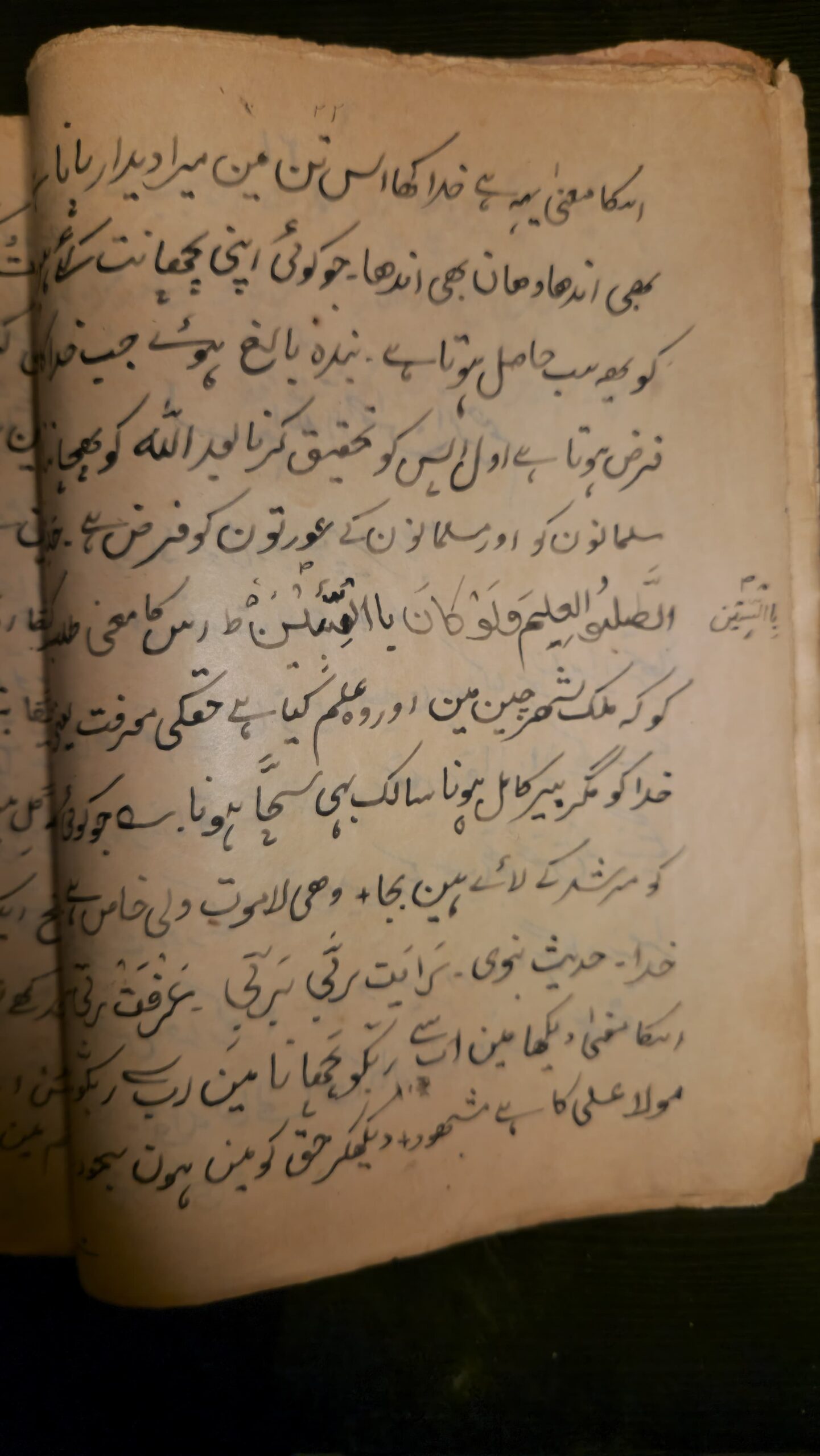
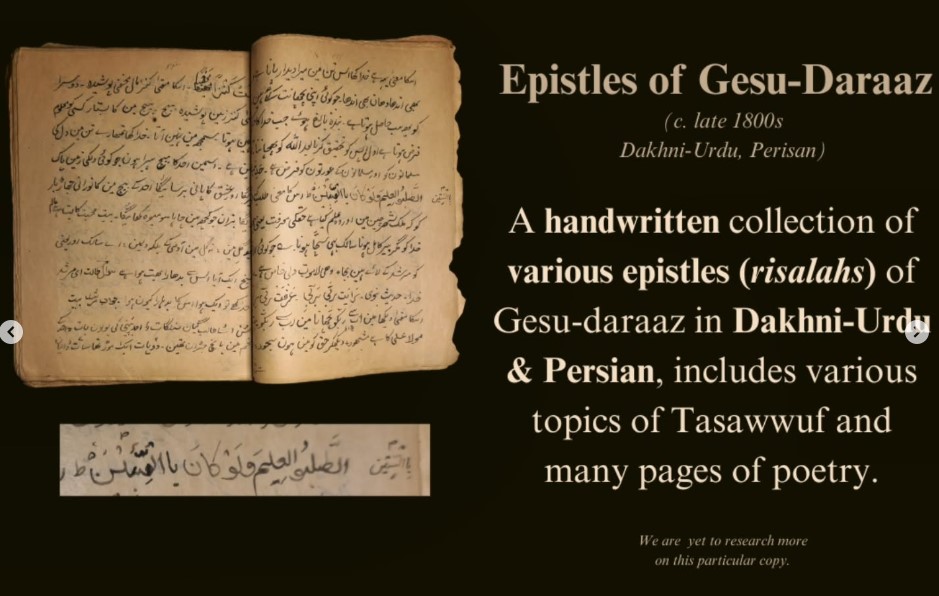
Khwāja Bandanawāz Gēsūdarāz (Sayyid Muhammad Husaini), born in Delhi on 4 Rajab 721 AH (30 July 1321 CE), and deceased in Gulbarga on 16 Dhu al-Qaʿda 825 AH (1 November 1422 CE), was a seminal figure in the transmission of Sufi traditions from North India to the Deccan. A descendant of immigrants from Herat, he accompanied his father to Daulatabad in 727/1327, when Sultan Muhammad bin Tughluq temporarily shifted the capital of the Delhi Sultanate. He returned to Delhi in 735/1335–36 and, the following year, became a disciple of the renowned Chishti saint Nasir al-Din Mahmud Chiragh-e-Dehli (d. 768/1367), who later bestowed upon him the title Gēsūdarāz, meaning “long locks.” For decades, Gēsūdarāz remained in Delhi as his master’s spiritual successor. In 1398, at the age of 77, he fled the city due to the imminent invasion by Timur. He first travelled to Gwalior, then through central India to Khambhat in Gujarat, and eventually made his way back to Daulatabad. In 802 AH (1399/1400 CE), at the invitation of Sultan Taj al-Din Firuz Shah Bahmani, he settled in the Bahmani capital of Gulbarga.
Although warmly received at first, Gēsūdarāz’s relationship with the Bahmani court eventually soured. Firuz Shah, a patron of the external sciences, grew critical of the saint’s emphasis on mystical theology. A core tension lay in Gēsūdarāz’s interpretation of Ibn ʿArabi’s works. Though Gēsūdarāz himself adhered to the metaphysical position of waḥdat al-shuhūd (unity of witnessing), distinct from Ibn ʿArabi’s waḥdat al-wujūd (unity of being), he nonetheless engaged deeply with the latter’s writings. When scholars at court raised suspicions over possible heterodoxy, an emissary sent to investigate Gēsūdarāz became his devotee instead. In 1407, due to growing unease at court, he was compelled to move his khānqāh away from the city’s fort. In 1415, further conflict arose when Gēsūdarāz endorsed the sultan’s brother Ahmad as successor rather than Firuz Shah’s son. These disputes were only resolved with Firuz’s death in 1422 and the accession of Sultan Ahmad Bahmani, who then commissioned the construction of a grand mausoleum over Gēsūdarāz’s hospice and tomb, which continues to serve as the principal site of Muslim pilgrimage in the Deccan.
Gēsūdarāz’s influence in the religious, intellectual, and literary life of the Deccan has been profound. A contemporary of major political upheaval and cultural transformation, he authored approximately 195 works in Arabic, Persian, and early Urdu, or Dakhni. His writings cover Sufism, jurisprudence, Hadith, Qur’anic commentary, and metaphysics, and include titles such as Sharḥ-i Tamhīdāt, Ḥazāʾir al-quds, Sharḥ-i ʿAwārif al-maʿārif, Asmār al-asrār, and Anīs al-ʿUshshāq. His corpus also includes commentaries on Suhrawardi and Ibn ʿArabi, which played a key role in diffusing Islamic mystical thought in India. Importantly, Gēsūdarāz was the first Chishti Sufi known to have composed works directly, rather than relying on disciples to record his teachings. He also wrote in Dakhni—a vernacular form of early Urdu spoken in South India—thereby expanding the accessibility of Sufi thought. His Mirāj al-ʿĀshiqīn, composed in Dakhni for a lay audience, exemplifies this outreach. Many verses in Dakhni attributed to him were later compiled under titles such as Chakkī-nāmah and survive in manuscript form, preserved both by scribes and through oral tradition. While attribution remains debated, editors such as Dr. Nazir and compilers like Muhammad Jamāl Sharīf consider some of these verses authentic. Following his death, Gēsūdarāz’s shrine became a center of royal patronage, supported successively by the Bahmanids, ʿĀdilshāhis, Qoṭbshāhis, Mughals, and the Nizāms of Hyderabad. His descendants have continued to administer the endowment supporting a mosque, school, library, and hostel attached to the shrine. His legacy remains foundational to both the spiritual and literary history of South Asian Islam.
Note: Some of his works are preserved in our collections: https://www.instagram.com/p/DJs8zTTzotn/?utm_source=ig_web_copy_link&igsh=MzRlODBiNWFlZA==
Note: This entry is an incomplete draft. More can be written about the saint from various other sources. We will be updating soon; and in the meantime, if you’d like to contribute to this entry — please do!
Further Readings:
1. Hashmi, Naseer-Uddin. Dakan MeiN Urdu. 1st ed., Taraqqi Urdu Bureau, 1985
2. Compiled by Prof. Mohiuddin Qadri Zore. Urdu Shah’paare. 1st ed., Urdu Academy A.P, 2009.
3. Hakeem Syed Shamsullah Qadri. Urdu-e-Qadeem: Urdu Zaban Ki Tareekh. 3rd ed., Matba Tej Kumar, 1967.
4. Shareef, Muhammad Jamaal. Dakan meiN Urdu Shayeri Wali Se Pehle. Edited by Muhammad Ali Asar. Hyderabad: Idara-e-Adabiyat-e-Urdu, 2004. -
Zore, Mohiduddin Quadri
Syed Mohiuddin Qadri Zore was a writer, scholar, poet, literary critic, historian, and social reformer from Hyderabad Deccan, India. He is celebrated for his profound contributions to Urdu language and literature. Born in Hyderabad, India, he received his early education at Dar ul Uloom Baldah (Hyderabad City) and later earned his M.A. in Linguistics from Osmania University.
Zore’s academic journey took him to London on a fellowship from the Nizam of Hyderabad, where he completed his Ph.D. in Linguistic Sciences at the University of London. He furthered his studies in Paris, focusing on phonetics, before returning to India. His scholarly career included serving as Principal of Chaderghat Government Degree College, heading the Urdu department at Osmania University, and later becoming Dean of the Faculty at Jammu and Kashmir University.
محی الدین قادری زور
(1905 – 1962)Throughout his life, Zore authored 61 books, ranging from poetry to scholarly criticism and linguistic analysis. Notable works include “Hindustani Lisaniat” (1932), shedding light on the evolution of Indo-European languages, and “Hindustani Phonetics,” a significant contribution to linguistics. His literary pursuits also encompassed historical and cultural studies such as “Tilism-e-Khayaal”, “Sayr-e-Golconda” and “Golconda ke Heeray,” exploring the rich heritage of the Deccan region.
Some of his works are listed below:
- Hindustani Lisaniat (1932) – A seminal work on the evolution of Indo-European languages.
- Hindustani Phonetics – A significant contribution to phonetics in English.
- Tillsm-e-Khayaal – Collection of essays.
- Sayr-e-Golconda – Historical study of Golconda.
- Golconda ke Heeray – Another work on Golconda’s history.
- Kulliyate Mohammad Quli Qutb Shah (1940) – Collection of poetry by Mohammad Quli Qutb Shah.
- Hayat-e-Mir Muhammad Momin (1941) – Biography of Mir Muhammad Momin.
- Dastane-adab Hyderabad (1951) – Stories of Hyderabad’s literature.
- Tazkira makhtutat Urdu Vols. II and III (1951 and 1957) – Compilation of Urdu manuscripts.
- Talib-o-mohni (1957) – Literary work.
- Maani sukhan (1958) – Collection of essays.
- Rooh-e-tanqueed, Vols. I and II (1927) – Critical works on Western principles of criticism.
- Urdu Shehpaare – A literary work.
- Urdu ke asaleeb-e-bayan – Work on Urdu grammar.
- Rooh-e-Ghalib (1939) – Critical study on Mirza Ghalib’s poetry.
- Sarguzasht-e-Garcin de Tassy – Historical work.
Dr. Zore’s e-books can be read on Rekhta: https://www.rekhta.org/authors/syed-muhiuddin-qadri-zor/ebooks?ref=web
Zore’s enduring legacy includes founding the Idare Adabiyaat e Urdu (known as ‘Aiwan-e-Urdu’), an institution dedicated to the preservation and promotion of Urdu literature, and initiating the Urdu magazine “Sabras.” His efforts played a pivotal role in promoting Urdu as a language of cultural and scholarly significance, influencing generations of scholars and enthusiasts worldwide.
Zore married Tahniath Unnisa begum, herself a noted Urdu poetess, and they had nine children. He passed away in 1962 in Srinagar, Kashmir, leaving behind a legacy that continues to shape Urdu literature and linguistic studies. His ancestral home, Tahniath Manzil, still stands in Hyderabad, adjacent to the Idara-e-Adabiyat-e-Urdu, a testament to his enduring influence and dedication to Urdu scholarship.
-
Naseeruddin Hashmi
Naseeruddin Hashmi was a writer, researcher and scholar of Dakhniyat (Deccan Studies) from Hyderabad, Dakan. “Dakan meiN Urdu (دکن میں اردو)” is the most famous work of his.
Naseeruddin Muhammad Abdul Bari was born in the respected Hashmi family of Hyderabad on 15th March 1895. He pursued his education in the Dar-ul-Uloom Hyderabad and graduated as a Munshi and Maulvi Aalim from the same institution. He was also a Munshi Fazil from Madras University.
After completing his education he joined the department of Central Record Office (دفتر دیوانی و مال) and retired as a registrar in 1950. He travelled throughout India’s different districts and states; and on the stipend provided by the Asafiya Sultanate, he visited Scotland, France, Italy and Britain for his research work. Karachi, Lahore, Busra, Baghdad, Karbala and Najaf Ashraf are the other places he visited.

نصیر الدین ہاشمی موت نے آج یہ کیا سخت ستم توڈا ہے
کتنی بے کس نظر آتی ہے وطن میں اردو
ایک دکنی جو اٹھا، سال یہ رحلت کا ملا
ہاشمی چل بسا، روتی ہے دکن میں اردو
84 (Dakni) – 1428 (Hashmi chal basa, roti hai dakan meiN Urdu) = 1384 Hijri
Akbaruddin Siddiqui composed this chronogram on the death of Hashmi.Hashmi Sahib’s book “Deccan Mein Urdu” initially published in 1922 gained immense popularity, growing from its original 180 pages to over 1,000 pages by its sixth edition in 1964, released shortly before the author’s demise. This expansion was fuelled by continuous revisions and additions, resulting in numerous reprints and editions by various publishers, both authorised and unauthorised.
The book became a catalyst for extensive research into Urdu language, focusing on its origins and development across different regions of India. Following its widespread acclaim, a plethora of articles and books emerged discussing Urdu’s birthplace and the contributions of diverse regions to its promotion. “Deccan Mein Urdu” not only proposed theories about Urdu’s origins but also featured biographical sketches of poets and writers who significantly influenced Urdu literature in the Deccan, accompanied by critical evaluations and excerpts of their work.
While the book initially posited Deccan as Urdu’s birthplace, subsequent editions and scholarly discourse, prompted by works like “Punjab Mein Urdu” and “Hindustani Lisaniyaat” by Dr. Mohiuddin Quadri Zore and others shifted focus to a purely linguistic analysis of Urdu’s roots. This evolution sparked discussions on Urdu’s development in regions such as Punjab, Delhi, Sindh, Bengal, and beyond, exploring the roles of various communities and ethnicities in fostering its growth.
Hashmi Sahib’s pioneering work thus laid the groundwork for a deeper understanding of Urdu’s linguistic evolution and its cultural significance across India, influencing generations of scholars and researchers in the field.
A list of his essays was published in the Hashmi-Number January 1965 edition of the Urdu monthly magazine – Sabras. Dr. Afzaluddin Iqbal mentions that his works are more than a thousand, and lists of some of them in the preface of “Dakan meiN Urdu”.
Some of his works are listed here:- Dakan meiN Urdu (first published in 1924, currently 7th or 8th publication is available)
- Salateen e Dakan ki Hindustaani Shayeri (1932)
- Hazrat Amjad ki Shayeri (1934)
- Madras meiN Urdu (1938)
- Maqaalaat e Hashmi (1939)
- Dakni Hindu aur Urdu (1956)
- Europe meiN Dakhni Makhtootaat (1932)
- Daftar e Diwani ke Urdu Makhtootaat (1935)
- Kutub-KHaana Salarjung ki Urdu Qalmi KitaaboN ki Wazahati Fehrist (1957)
- Zikr e Nabi sal Allahu alayhi wa sallam (1934)
- Tazkirah Dar ul Uloom (1944)
- Ahd e Aasfi ki Qadeem Taleem (1946)
- Aaj ka Hyderabad (1953)
- Jung e Aazadi ki Kahaani (1957)
- Maulvi Abdul Qadir (1963)
- Dakni Culture (1963)
- Khawaateen e Ahd e Usmani (1936)
- Janaabaan e Niswaan (1938)
- Khawaateen e Dakan ki Urdu Khidmaat (1940)
- Hyderabad ki Niswaani Dunya (1944)
- Tazkirah Hayaat Bakhshi Begum (1952)
- Najm us Saaqib – Shafa’i Fiqh (1924)
- Rahbar e Safar e Europe (1930)
- Film-numa (1940)
- Maktoobaat e Amjad (1944)
- Zubedah ke Des meiN (1955)
Some of the e-books can be read on Rekhta: https://www.rekhta.org/authors/naseer-uddin-hashmi/ebooks?ref=web
-
A guide on Dakhni Scholars and their works
Draft to be published soon…
-
A brief time-line of Dakhni Poets
Bahmani Period
- Sayyid Muhammad Husaini Gesu-daraaz
- Nizami
- Lutfi
- Shah Meeraanji Shams-ul-ushshaaq
Qutub Shahi Period
- Feroz
- Khayaali
- Wajhi
- Sultan Muhammad Quli Qutub Shah
- Ghawwasi
- Ahmad
- Qutbi/Razi
- Sultan
- Khudawand e Khudanuma
- Balaaqi
- Ibn e Nishati
- Tab’ii
- Shah Raju Husaini
- Taana Shah
- Muhib
- Kabir
- Ghulam e Ali
- Fayez
- Afzal
- Fattaahi
- Keshaw
Adil Shahi Period
- Burhanuddin Janam
- Ibrahim Adil Shah
- Abdul
- Aatshi
- Muqeemi
- Ameen
- Shauqi
- San’ati
- Malik Khushnood
- Rustumi
- Daulat
- Ali Adil Shah Shahi
- Nusrati
- Shah Ameenuddin
- Zahoor
- Hashmi
- Ayaaghi
- Shughli
- MuKHtar
- Qudrati
- Momin
- Qaadir
- Shah Man Arf
Nizam Shahi Period
- Ashraf
- Aaftaabi
- Shauqi
Burayd Shahi Period
- Quraishi
Mughaliya Period
- Wali Dakhni
- Mahmood Behri
- Za’eefi
- Turaab
- Husain
- Zauqi
- Mujrimi
- Bulbul
- Darya
- Abdul Muhammad Tareen
- Wali Vellori
- Ishrati
- Ruhi
- Bechaara
- Firaaqi
- Shah Tahir
- Shah Abdur Rahman
- Abdul Jaleel
- Zakir
Asafiya Period
- Aasif
- Naasir
- Siraaj
- Saarim
- Abdaal
- Shah Mir
- Dargah
- Hidayat
- Shaida
- Shafeeq
- Tamanna
- Tajalli
- Imaan
- Kazim
- Ziya
- Syed Shah Abdul Qadir
- Shah Ghulam Husain
- Shah Waliullah
- Shah Mir
- Shadaan
- Eemaa
- Qais
- Chanda
- Kamtar
- Natiq
- Sukhan
- Laeq
- Khaamosh
- Makhan
- Jauhar
- Iqbal
- Baaqi
- Ash’har
- Paas
- Khurram
- Ranj
- Ramz
- Fayyaz
- Wazir
- Waasil
- Walaa
- Amjad
- Ameer
- Baazigh
- Aasifi
- Taufeeq
- Hilm
- Dil
- Shaad
- Hasrat
- Safi
- Kaifi
- Muhib
- Nazm
- Jaleel
- Zaamin
- Usman
- Farhat
- Akhtar
- Ismat
- Abr
- Ja’far
- Mohr
- Aali
- Wafaa
- Hairat
- Najm
- Manzoor
- Fazl ur Rahman
- Wajd
- Makhdoom
- Maikash
- Armaan
- Badr
- Lam’aa
- Jaami
- Barq
- Baaqi
- Shahid Siddiqui
- Dahqaani
- Asar
- Tahniyat
- Ruhi
- Tahira
- Naaz
- Aneesa
- Aseer
- Basheer
- Misses Barkat Rae
- Qamar
- Latif
- Naushaaba
- Naseem Waheeda
- Sughra Begum Humayun Mirza
- Badshah Begum Sufi
- Rabia Begum
- Jahan Banu Begum
- Zeenat Sajidah
- Munirah Banu Kausji
- Misses Shaanti Baai
-
Birth of a Sher – Vatsal Sharma
Mir says:
Dii aag rang-e-gul ne waaN ai sabaa chaman ko
YaaN ham jale qafas meiN sun haal aashiyaaN kaRang-e-gul – colour/style of rose, waaN – wahaaN, sabaa – morning-breeze, chaman – garden, yaaN – here, qafas – cage, aashiyaaN – nest
It would be a sin to translate this, so I would just provide the literal, for-the-sake translation done by Frances Pritchett:
There, the color/style of the rose set fire, oh spring-breeze, to the garden
Here, we ‘burned’ in the cage, having heard the condition/state of the nestDo not ask ‘why’ after reading the couplet; instead, ask ‘what.’ It is not for us to know ‘why’ the rang-e-gul has set fire to the chaman/garden (at least not initially); I say this because these are ever-lasting metaphors and their effect can exist even if you do not understand why they are performing their actions. So, now ask, what is happening?
There is a bird inside a cage (qafas), and the morning wind (sabaa) has come to visit. The bird says to the wind: “colour/style of rose (rang-e-gul) was destroying/setting fire to (aag dena) the garden (chaman) and here, I was ‘burning’ in the cage (qafas) having heard the condition (haal) of the nest (aashiyaaN).”
I would not consider this any less than a story. You do not agree? It works well with the definition and the six elements of tragedies given by Aristotle:
Tragedy – a process of imitating an action which has serious implications, is complete, and possesses magnitude; by means of language which has been made sensuously attractive, with each of its varieties found separately in the parts; enacted by the persons themselves and not presented through narrative; through a course of pity and fear completing the purification (catharsis) of such emotions.
Overlooking the physical aspects of the definition, we can see that the couplet:
- has serious implications (raises pity and fear in a general and psychological sense) – the captivity, helplessness of the bird, the burning of her nest and garden and her ‘burning’ desire to be there validates this
- might not be complete story in the sense of having a beginning, middle and an end, but it implicates towards all of those since it is a dialogue from a character
- language is sensuously attractive (without a doubt) and relevant as well
- though this is not enacted by people, but when you read it, you are the one enacting it, and the powerful use of language enables effect even if you read it in a toneless manner
- this couplet catharsises the reader in a way that it manifests a very common thought of inability in a fluid manner
Aristotle gives these six elements of a tragedy:
- Plot – see how the couplet unfolds:
This meter has a quasi-caesura break at the middle. Think of this break as a stress or a breath taken after “ne” in the first and “meiN” in the second line. So, when we recite this couplet in a flow, it is divided in four perfect parts (or as tragedy would have it, acts).
- The first part: dii aag rang-e-gul ne. It introduces a character (rang-e-gul) and tells us of its actions. We do not get to know much, but we get a somewhat idea as to where we’re heading and it does not seem like a good place.
- The second part: waaN ai sabaa chaman ko, the word waaN (wahaaN) tells us that the character who is speaking this dialogue is far from the scary action in the first line. This should be a good thing, right? Yes, we think that so far. In this part the character being spoken to (sabaa) is introduced, and we are told that the villain (rang-e-gul) is setting fire to the garden. What relation does the speaker have with the garden? We don’t know. We just know that he/she is in a safer place.
- The third part: yaaN ham jale qafas meiN, we finally get to know where the speaker is: in a cage. This union of yahaaN (yaaN) and wahaaN is a simple way of speaking, for example, “wahaaN pe tum maze kar rahe ho yahaaN mere exam chal rahe hai.” We also get to know that our speaker is ‘burning.’ We thought the speaker would be happy, given that he/she is not in the burning garden. Why is this happening?
- The fourth part: sun haal aashiyaaN ka, this part gives us the reason to the last part and enough to predict. The speaker is ‘burning’ because he/she heard the condition of the nest; quite possibly their own nest. It is implied that the nest is in the garden, and who lives in a nest? That’s right. A bird.
That was a roller coaster ride of feelings.
Aristotle also believes for plot to be the most important element, and as you can see here, in mere 19 words a story has been unfolded in perhaps a cathartic way.
- Characters – bird is the tragic hero, morning breeze is a sort of middleman, rang-e-gul is the villain.
- Diction/verbal expression – the dialogue is implicating, layered, idiomatic, colloquial and fluid. The idiom of aag dena, metaphor of rang-e-gul, the simple yet powerful waaN, the duality of jale, the falling of the “l” in “haal” on “aashiyaaN” can be appreciated in detail, alas: “had we but world enough and time.”
- Spectacle/visual adornment – in context of a tragedy these are decorations of the stage, and they are intended to bring the audience closer to the scene of the play. Though the couplet is not a play, the imageries or the spectacles created by it are unparalleled. A play on the stage would find it difficult to convey scenery like this through decoration.
- Thought – this is the mental pattern of the characters over the course and we can see how the speaker’s way of speaking (if not his thoughts) goes through different shades of thought.
- Song – the couplet flows like water and a sher is part of a song if not one in itself.
I hope a convincing case has been made. Now, is this my whole argument that a sher is a story? But, what if I tell you that there is a lot more to it?
As any speaker of Hindi-Urdu would know “jalna” is relevant for jealousy as well. We never really paid attention to the captivity aspect in our tragic hero’s life, right? Let’s take the “jale” in second line this new view.
Now, the lament becomes about the captive bird’s condition and not about the garden or the nest. The bird has become jealous hearing the state of her (burning) nest. Why? Perhaps because anything is better than this captivity or watching her garden and nest burn helplessly.
You can probably recall the scene from The Dark Knight Rises where Bane takes the broken Batman to the underground prison and forces him to watch his city ‘burn;’ before Batman gets his courage back he asks the prisoners to kill him, even if for pleasure. This reading of the couplet is much more sadistic and highlighted a different level of tragedy.
Shamsur Rahman Faruqi provides an interpretation where he considers the fire to be metaphorical. Instead he says the rose has lit up the garden with its illumination, but because the speaker is not there the nest is dark.
It is interesting to treat it as a metaphorical fire, and it provides with these ideas:
- The speaker has become jealous/envious having heard the illumined, decorated condition of the nest.
- The speaker is glowing/radiating out of happiness as the good news of the illumined, decorated nest has reached.
If you have made it this far, then you have successfully participated in a 1,214 word long discussion on a sher of 19 words. And believe me I can probably bring out a few more ash’aar (plural of sher) that can prove the same things. But what is my point exactly? Because it is clear that a sher is not just a story. So what is it or more like what do I think it is?
This couplet – like many other couplets – is an essence (or as Sanskrit would have it: saar) common to various stories. Merriam-Webster defines essence as:
“the permanent as contrasted with the accidental element of being.”
So, in this couplet, the essence of various stories relevant to the characters remains captured like the bird. This characteristic of “various” comes through the use of rich words; for example, the word rang is Persian, and you would lose your mind if you see the various meanings given to it in Urdu and Persian dictionaries, however, here I have selected a few that I have found relevant from Platts and Steingass:
“Colour, imposture, playfulness, pleasure, condition, manner, dishonour, grief/pain, desire, game at dice, possessor, blood, an old patched garment, like/resembling, beauty/bloom.”
You can easily come up with entirely different tragedies or something else if you make use of these meanings in the couplet.
Personally, I do not focus on these back-stories, rather I enjoy the rushing effect that the sher has, I believe for it to be the primary pleasure. But, I do believe these stories are necessary to the birth of sher. It is well known that the meaning of the word ghazal was to talk to women. However, over the time only talk has remained. And as it was said earlier, this couplet is a proper dialogue with speaker, subject and addressee.
So, the poet stands in the centre of imagination or certain situation (which is not of any reader’s business) and is able to capture the essence of the story in such a way that it has an instant effect on the reader/listener and it can also provide for the reconstruction of various such situations or imaginations.
Here is a rather funny example:
There is a story about the two poets Jurat – who was blind – and Insha where the former was immersed in his thoughts. Insha came and asked, “where are you lost?”
Jur’at said, “nothing, I have a line, but cannot think of the other to complete the couplet.”
To this Insha asked Jurat to tell him the line so that he could help, but the blind poet remarked that the latter will instead make a couplet of his own (this is insulting indeed). But, Insha requested again and then Jurat told him the line:
us zulf pe phabtii shab-e-diijuur kii suujhii
This could perhaps translate to, “on that hair the decoration of the dark night was made apparent.” So, Insha – to help his friend – provided with a second line immediately:
andhe ko andhere meiN baDii duur kii suujhii
In response to this, blind Jurat picked up his stick and tried to catch Insha and for enough time the poor bloke kept trying.Our focus is the second line, which Insha immediately composed. He had already said that he would help with the second line and after that he was even teased/accused/insulted by his friend – this is the situation in which the poet of this line stands. And the second line that he composed immediately is the essence of the situation that remains relevant and satisfies both the first line as well as Insha’s desire to tease Jurat back. So basically, when Insha composed this couplet he worked as two different speakers: one for the first line and second for his own personal agenda. These things that I specified in useless detail about this couplet subconsciously enable us to take instant pleasure as we hear the entire anecdote; this can be supported with a little experiment, that is, recite this whole couplet to one person without telling the anecdote and then to another after telling the anecdote and you will see that the latter will have a greater pleasure. This is perhaps because the speaker of the couplet has a duality that is only activated with this situation that he was in.
Before reaching near conclusion, I can say that a ghazal poet takes forms of various characters sher after sher: he becomes a drunkard, madman, lover, saint, bird, ghost, omnipresent narrator, etc. in a mere sequence of breaths. This makes me perceive the ghazal world as a never-ending, all-mood, stage-less play (this raam-kahaani) where the characters are only in control of their dialogues and the writer of the plot is fate. So, here are a few couplets at last that strengthen this idea of mine:
Mir says:
gham-e-zamaana se FaariG hai maaya-baaKHtagaaN
qimaar-KHaana-e-aaFaaq meiN hai haar hii jeetTranslation:
Those that played and lost their wealth are free from grief of the world
In the gamble-club of horizons, to lose is to winThis gives the view of a down-trodden tragedy hero who opens to his audience (the world) this depressing revelation.
Ghalib says:
muNh na khulne par ye aalam hai ki dekhaa hii nahii
zulf se badh kar naqaab us shoKH ke muNh par khulaaThis is a couplet telling an entire story just as well. I will attempt to explain it next time.
waaN khud-aaraai ko tha motii pirone ka KHayaal
yaaN hujuum-e-ashq meiN taar-e-nigah naa-yaab tha
yaaN sar-e-pur-shor be-KHwaabi se tha deewaar-juu
waaN wo farq-e-naaz mahv-e-baalish-e-kam-KHwaab tha
waaN hujuum-e-naGma-haa-e-saaz-e-ishrat tha ‘Asad’
naaKHun-e-Gam yaaN sar-e-taar-e-nafas mizraab tha – GhalibTranslation:
There, Self-Adornment had the thought of stringing pearls
In the rush of tears the string of gaze was un-findable here
Here, the noisy head was seeking a wall out of sleeplessness
That summit of coquetry was absorbed in pillows of silk there
There was the rush of songs of instrument of joy ‘Asad’
The nail of grief, on the string of breath was a plectrum hereThis seems like a complete song where an overly-emotional lover laments about his helplessness and loss of love.
Couplets like these show us how important mat sahl hameiN jaano is in Mir’s infamous, prophetic sher:
mat sahl hameiN jaano phirta hai Falak barsoN
tab khaak ke parde se insaan nikalte haiTranslation:
Do not consider us simple.. the sky revolves for ages
Then from the veil of dust.. human beings emergeThe first four harmless words establish a dialogue between innumerable characters of which you are a part as well.
At last, Intizar Hussain said that Mir appears like a great novelist. I have only tried to prove it.
Vatsal Sharma is an Urdu and English writer from Jaipur. In ghazals he practises classical Urdu sheriyaat. He is currently working on Mir Taqi Mir’s divaan and runs a page on instagram: @theonlypoetrypage.
-
Non-Indian & Non-Muslim Poets of “Urdu”
Urdu, usually associated with the Muslims of the Indian sub-continent, is a language that, even though was born and developed in India, is still perceived as an alien language to the land. The reasons behind such perception are several historical and linguistic misconceptions about the language that are backed by political factors. The idea behind writing this piece is to make an attempt at clearing these misconceptions by briefly discussing the history of its literature.
“What’s in a name?
That which we call a rose by any other name would smell just as sweet.”
(Shakespeare, Romeo and Juliet)The language had many names before being known as “Urdu”. Depending on the different space-times, the language was called as – Hindavi, Dehlvi, Gujri, Dakhni, Lahori, Lashkari, Hindoostanee and Hindi. The script was Perso-Arabic, its syntax/grammar and phonology Indian; and apart from many loanwords from Persian, all the verbs were derived from Prakrit and Sanskrit. The word “Urdu” came much later in the end of 18th century – when this language replaced Persian at the Mughal court, and colonists like John Gilchrist (1759-1841) started propagating a division in the language (not based on any linguistic grounds, but based on communal grounds, although being a linguist himself), which was then picked by the Hindu Nationalists and certain Muslim political groups that supported the idea of a separate independent state for Muslims carved out of the British-India. During this period, the language was forced to be written in a recently developed script “Devanagari” and many loan words of Persian origin were replaced by Sanskritised words – making it ‘Hindi for Hindus’, and the same language when written in its original Perso-Arabic script – ‘being Urdu for Muslims’. As said earlier, the difference between Hindi & Urdu was communal rather than linguistic. Later on, the word “Urdu” which also has one of its meanings as “army camp” in Turkish, was used to create a pseudo-history of the language – claiming that the language came with the Muslim invaders and is therefore named as “army camps”.
“A Martian Scientist would conclude that all earthlings speak dialects of the same language.”
(Guy Duetscher, from “NoamChomsky on Anarchism”)Apart from the linguistic studies of the language – like the language-family-tree of Urdu, and how different diglossia/dialects of the same language are confused and framed as different due to various reasons (mainly political) – the literary history of this language clearly shows that the language was born and developed in the Indian sub-continent by its inhabitants – both Hindus and Muslims (and even Sikhs and Christians) – and is still, although with lots of struggles, being carried by them.
From the 14th century – when early traces of the language being spoken and used for literature are found in its primordial forms – to the late 20th century – when the language became known all over the world with a literary heritage of more than 400 years; poets like Kabir (d. 1518) and Raghupat Sahay Firaq (d. 1982) are mentioned; whereas – Ajay Chand Bhatnagar (d. 1550s), Tek Chand Bahar (d. 1766 Persian lexicographer), Budh Singh Qalandar (d. 1780s), Teka Ram Tasalli (1780s), Raja Ram Narayan Mauzoon (d. 1762), Jaswanth Singh Parwana (d. 1813), Ratan Nath Sarshaar (d.1903), Brij Mohan Kaifi (d.1954) and many others are often forgotten while mentioning the literary history of Urdu.
Although a work is yet to be done on these classical writers, poets and scholars of the language, Syed Bashir Ahmad (PhD, Osmania University, Hyderabad) has compiled brief biographical notes along with some literary works of non-Muslim writers in Hyderabad post-1947. This work – titled “Hyderabad meiN ghair-MuslimoN ki Urdu KHidmaat (Urdu-literary services of non-muslims in Hyderabad) – is even more interesting when contextualised by the partition of British-India into Muslim-majority Pakistan and Hindu-majority India, and further by the annexation of the erstwhile Hyderabad State (which was an independent state ruled by a Muslim with a population of Hindus in majority) by the Government of India in 1948. During which, mass-migrations and displacement of different communities occurred, and with them, the languages believed to be associated with them also suffered.
Another less focused area is the contribution of Europeans – not as aliens, but as native speakers (whether or not having Anglo-Indian descent) to this language. Some works like – “Ahl e Europe ne Urdu ki kya KHidmat ki?” (What service did the Europeans do to Urdu?) by Maulvi Abdul Haq (1870 – 1961) and “Europian Sho’ra e Urdu” (European Poets of Urdu) by Sardar Ali – do show an attempt made at this research.
Most notable of such works is “European & Indo-European Poets of Urdu & Persian” written by Ram Babu Saxena and published in 1941 by Nawal Kishore Press, Lucknow.Unfortunately, not much attention has been paid – apart from certain political slogans and academic discussions – on this topic; and due to the lack of awareness, the divide has further increased in the common public narratives, and led to the marginalisation of Urdu (by attaching it to the Muslim minority of India). I intend to study the history of this in greater detail in the upcoming years.
مقدور ہو تو خاک سے پوچھوں کہ اے لئیم
تو نے وہ گنج ہائے گراں مایہ کیا کیے
if there would be the power/ability/presumptuousness,
then I would ask the dust: ‘Oh wretch/miser,
what did you do to/with those valuable treasures?!
– Ghalib
(translated by Prof. Frances Pritchett, UoC)